

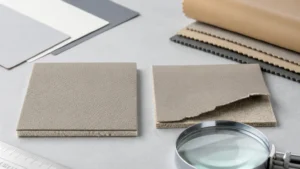
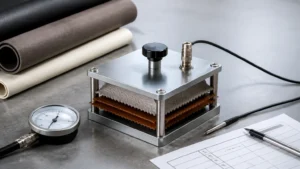
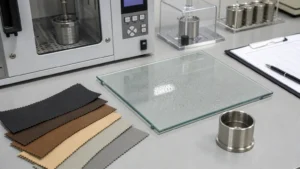
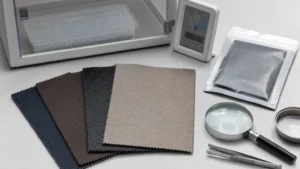
A synthetic leather scratch resistance test evaluates how well the surface coating resists visible scratches, whitening, gloss change, coating breakage, or permanent marks caused by localized contact. It is different from abrasion testing, which measures repeated wear, and from rubbing color fastness testing, which measures color transfer. For buyers, scratch resistance is especially important for car interiors, furniture, bags, shoes, and sports equipment that may contact keys, nails, buckles, tools, sand, or frequent handling.
What Is a Synthetic Leather Scratch Resistance Test?
A synthetic leather scratch resistance test is used to judge how the finished surface responds when a hard or sharp object moves across it under controlled conditions. The purpose is not only to see whether a mark appears. A useful test also records how severe the mark is, whether the topcoat is broken, whether the color changes, and whether the mark remains after wiping.
In synthetic leather, the visible surface is usually a coating or finish layer. That layer may include a PU, PVC, silicone, microfiber-based, water-based, solvent-free, or other engineered surface system. When the coating is too soft, too thin, poorly bonded, or chemically weakened, local contact can leave a white line, shiny streak, cut mark, or exposed base layer.
A quick fingernail check can help a buyer screen a sample, but it is not enough for formal approval. A formal synthetic leather scratch resistance test should define the tool, load, angle, path, speed, number of cycles, viewing method, and pass/fail criteria. Without those conditions, the phrase “scratch resistant” is too vague to support a purchasing decision.
Synthetic Leather Scratch Resistance Test vs Abrasion and Rubbing Tests
Buyers often confuse scratch resistance, abrasion resistance, and rubbing color fastness because all three relate to surface durability. They are connected, but they do not measure the same failure mode. A material may perform well in one test and still fail another, so a synthetic leather scratch resistance test should always be read together with abrasion and color fastness data.
| Test | Main Purpose | Typical Damage Observed | Buyer Meaning |
|---|---|---|---|
| Scratch resistance | Resistance to localized surface marks | White line, coating cut, gloss change, permanent mark | Keys, buckles, fingernails, tools, sharp edges |
| Abrasion resistance | Resistance to repeated wear | Surface wear, grain loss, coating wear-through, base exposure | Long-term seat, bag, footwear, and furniture use |
| Rubbing color fastness | Resistance to color transfer | Dye or pigment transfer onto rubbing cloth | Clothing contact, light-colored upholstery, repeated handling |
For repeated wear performance, buyers should review the Martindale abrasion test for synthetic leather. For color transfer, light fading, and yellowing, Taite’s guide to PU leather color fastness explains a different set of risks. Scratch resistance fills another gap: local surface damage caused by harder contact points.
Why Scratch Resistance Matters for Synthetic Leather Buyers
A synthetic leather scratch resistance test matters because many finished products fail in visible areas before the whole material wears out. A seat cover, handbag, shoe upper, or sports grip may still have good thickness and strength, but one visible scratch on the surface can make the product look low quality.
In car upholstery leather, common risks include keys, metal parts on clothing, child seats, pet contact, cleaning tools, and daily entry friction. A car interior material needs a surface that can resist small contact marks while still staying comfortable, flexible, and stable in heat.
For furniture leather fabric, the risk often comes from fingernails, zippers, buttons, pet claws, and household cleaning. A sofa or chair may face light scratching many times a week, so buyers should not rely only on one abrasion number.
For bag fabric, scratch marks can come from zippers, buckles, table edges, jewelry, cosmetics, and repeated hand contact. Glossy, metallic, embossed, or light-colored finishes may show scratches more clearly than matte and textured surfaces.
In footwear, PU leather for shoes may contact steps, stones, pedals, and rough ground. For sports equipment, a grip fabric may contact hands, sweat, tools, floors, or repeated handling. Each application needs its own test condition.
Common Synthetic Leather Scratch Resistance Test Methods
There is no single universal synthetic leather scratch resistance test that fits every application. The right method depends on the product, surface finish, customer requirement, and expected damage risk. However, most methods follow the same principle: apply a controlled contact tool to the material surface, then evaluate the visible result.
For coating systems, ISO 1518-1 is commonly referenced for determining scratch resistance of paints and varnishes under defined conditions. Synthetic leather is not always tested directly under this standard, but the coating scratch concept is useful because synthetic leather performance often depends on topcoat durability. Buyers should confirm whether the supplier uses a coating scratch method, an internal stylus method, or an application-specific evaluation.
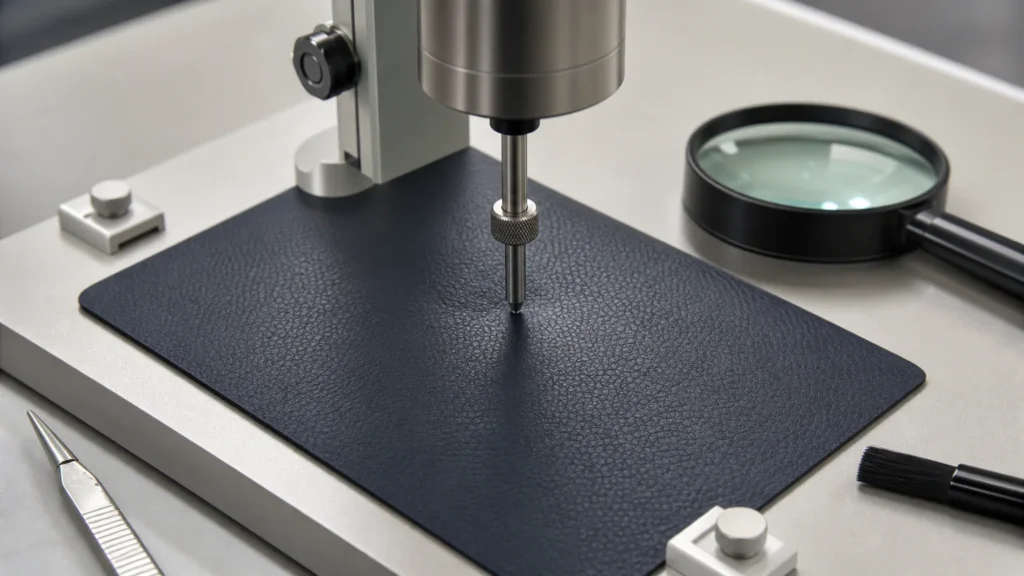
Stylus or needle scratch test
A stylus or needle synthetic leather scratch resistance test uses a controlled contact point to move across the material surface. The test may define the stylus shape, load, speed, path length, and number of passes. After testing, the sample is inspected for whitening, gloss change, coating cuts, and whether the mark reaches the base layer.
Fingernail or coin simulation test
A fingernail or coin simulation is closer to daily use, especially for bags, furniture, and car interiors, and it can support a controlled synthetic leather scratch resistance test. It is useful for quick screening, but it can be subjective because finger pressure, coin edge, angle, and speed are not always consistent. It should support, not replace, controlled testing.
Coating adhesion observation after scratching
Sometimes the scratch line itself is not the only problem. If the scratch opens the coating and the surface starts to peel, the issue may relate to coating adhesion. Taite’s article on coating adhesion and peel strength explains why bonding between layers affects long-term durability.
Application-specific scratch evaluation
Some buyers define their own scratch evaluation based on the final product. An automotive buyer may focus on trim contact and cleaning exposure. A bag brand may test buckle contact and tabletop rubbing. A footwear buyer may add flexing after scratching. This is often more useful than a generic claim because it reflects the real application.
How to Judge Scratch Test Results
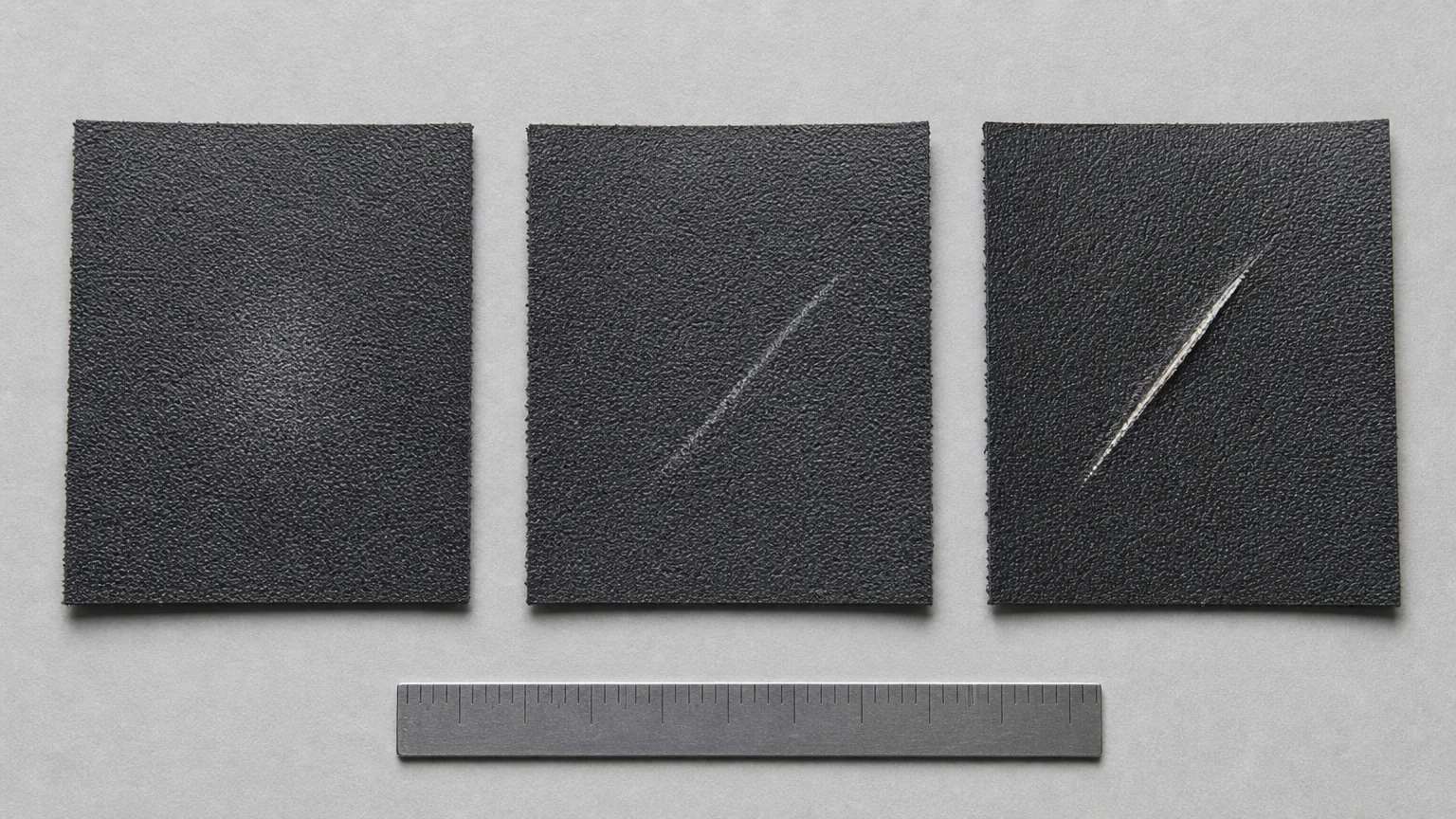
A good synthetic leather scratch resistance test report should include more than “pass” or “fail.” Buyers need enough detail to understand what happened and whether the result matches the final application.
- Check whether a visible scratch line appears under normal light.
- Check whitening, color change, or gloss change under angled light.
- Check whether the topcoat is cut through.
- Check whether the base layer or backing becomes visible.
- Check whether the mark can be wiped away after testing.
- Compare before and after photos under the same lighting.
- Record the tool, load, path, cycles, angle, and environment.
The final judgment should match product expectations. A hidden internal surface may allow small gloss changes. A visible car seat, handbag panel, or furniture surface may require stricter visual approval. The same result can be acceptable in one product and unacceptable in another.
What Causes Poor Scratch Resistance?
Poor performance in a synthetic leather scratch resistance test usually comes from the surface system, not only the total material thickness. A thick synthetic leather can still scratch easily if the topcoat is weak, poorly cured, or poorly bonded to the lower layer.
Common causes include a topcoat that is too soft, a finish layer that is too thin, weak coating adhesion, resin selection that does not match the application, plasticizer migration, insufficient curing, or a surface texture that makes scratches highly visible. Very smooth and glossy surfaces often show marks more clearly than textured or matte surfaces.
Chemical exposure can also reduce scratch resistance. Repeated contact with strong alcohol, solvents, disinfectants, or harsh cleaners may soften or weaken the surface. If the product will be cleaned frequently, Taite’s guide on using alcohol on synthetic leather can help buyers understand cleaning compatibility. Odor and surface chemistry can also be connected, so the article on why synthetic leather smells may support broader material evaluation.
Thickness still matters, but it is not the whole answer. A buyer should read Taite’s guide to synthetic leather thickness together with surface durability data. Scratch resistance is mainly about the upper surface and its finish quality.
How to Improve Scratch Resistance in PU and Synthetic Leather
Improving results in a synthetic leather scratch resistance test requires balance. A harder surface may resist scratches better, but if it becomes too stiff, it may reduce softness, comfort, flex resistance, or low-temperature performance. Good material design should match the final product, not chase one test number alone.
For PU leather, improvement may come from a stronger topcoat system, better resin formulation, optimized surface finishing, stronger coating adhesion, and careful control of grain texture. Water-based PU leather and solvent-free PU leather may be selected when buyers also care about lower-VOC or cleaner production requirements, but scratch resistance still needs to be tested on actual samples.
Silicone leather may be considered for easy-cleaning and high surface-resistance applications, while microfiber leather may offer structural stability and premium hand feel depending on the construction. The best choice depends on the surface finish, application, target hand feel, budget, and test requirements.
Scratch resistance should also be reviewed together with synthetic leather flex testing and cold crack testing. A surface that resists a scratch in the lab still needs to survive bending, temperature changes, repeated use, cleaning, and production handling.
Buyer Checklist Before Approving Scratch-Resistant Synthetic Leather
Before approving a scratch-resistant synthetic leather, buyers should ask for clear synthetic leather scratch resistance test conditions and sample evidence. A strong claim without conditions is difficult to compare across suppliers.
- What tool, stylus, needle, coin, or contact edge is used?
- What load or pressure is applied?
- How many scratches, passes, or cycles are tested?
- Is the test dry, wet, after cleaning exposure, or after aging?
- Is the test performed on the final color, grain, and finish?
- Are before and after photos provided under the same light?
- Is the result compared with abrasion and color fastness data?
- Is the pass/fail rule matched to the final product application?
If your project requires a scratch-resistant surface for automotive, furniture, bags, shoes, or sports equipment, ask Taite to test actual swatches under your application conditions before bulk production. You can contact Taite with your target application, cleaning requirement, surface finish, and expected test condition.
Frequently Asked Questions
What is a synthetic leather scratch resistance test?
A synthetic leather scratch resistance test is a surface durability test that checks whether the material develops visible scratches, whitening, gloss change, coating cuts, or permanent marks after controlled local contact.
Is scratch resistance the same as abrasion resistance?
No. A synthetic leather scratch resistance test focuses on localized marks from harder contact points, while abrasion resistance focuses on repeated wear over a larger surface area.
Can PU leather be scratch resistant?
Yes. PU leather can be designed with improved scratch resistance through better topcoat formulation, coating adhesion, resin selection, grain design, and application-specific finishing. The actual performance should still be tested on the final sample.
Which synthetic leather is best for scratch resistance?
There is no single best material for every product. PU, silicone, microfiber, and other synthetic leather systems can be engineered for different levels of scratch resistance. The best option depends on application, feel, cleaning exposure, color, grain, and cost target.
Does thicker synthetic leather always resist scratches better?
No. Thickness can support overall strength, but the result of a synthetic leather scratch resistance test depends mainly on the surface coating, finish quality, adhesion, and how visible marks appear on the final color and grain.
Can cleaning chemicals reduce scratch resistance?
Yes. Strong solvents, high-concentration alcohol, harsh disinfectants, or incompatible cleaners may weaken the surface coating and make scratches, whitening, or peeling more likely.
What should buyers ask before approving scratch-resistant synthetic leather?
Buyers should ask for the test tool, load, path, cycles, sample color, grain, environment, photos, and pass/fail standard. The requirement should match the final use case, not just a generic laboratory claim.