

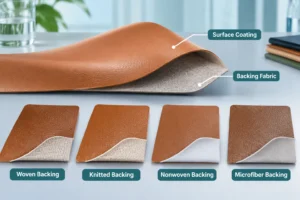
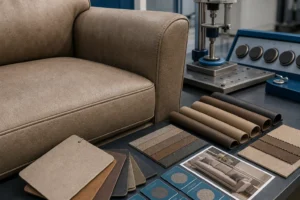
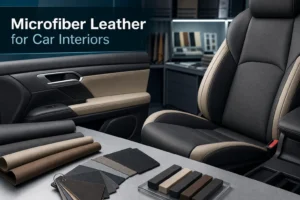
Synthetic leather backing fabric is the base layer under the PU, PVC, silicone, or other surface coating. It gives the material strength, stretch control, tear resistance, sewing stability, softness, and dimensional support. Woven backing is usually chosen for strength and stability, knitted backing for stretch and flexibility, nonwoven backing for softness or cost efficiency, and microfiber backing for higher durability and a more leather-like structure. Buyers should choose backing fabric according to the final product, coating system, thickness, flexing, seam stress, and required test performance.
Many synthetic leathers look similar from the surface. The grain, color, gloss, and hand feel may appear close, but the base layer can make the final performance very different. A material for a structured bag, a sofa seat, a shoe upper, a medical chair, or a car interior panel may need a different backing even if the surface coating looks almost the same. For B2B buyers, backing fabric is not a minor detail. It is one of the main reasons why two similar swatches can behave differently during cutting, sewing, stretching, upholstery, flexing, and long-term use.
What Is Synthetic Leather Backing Fabric?
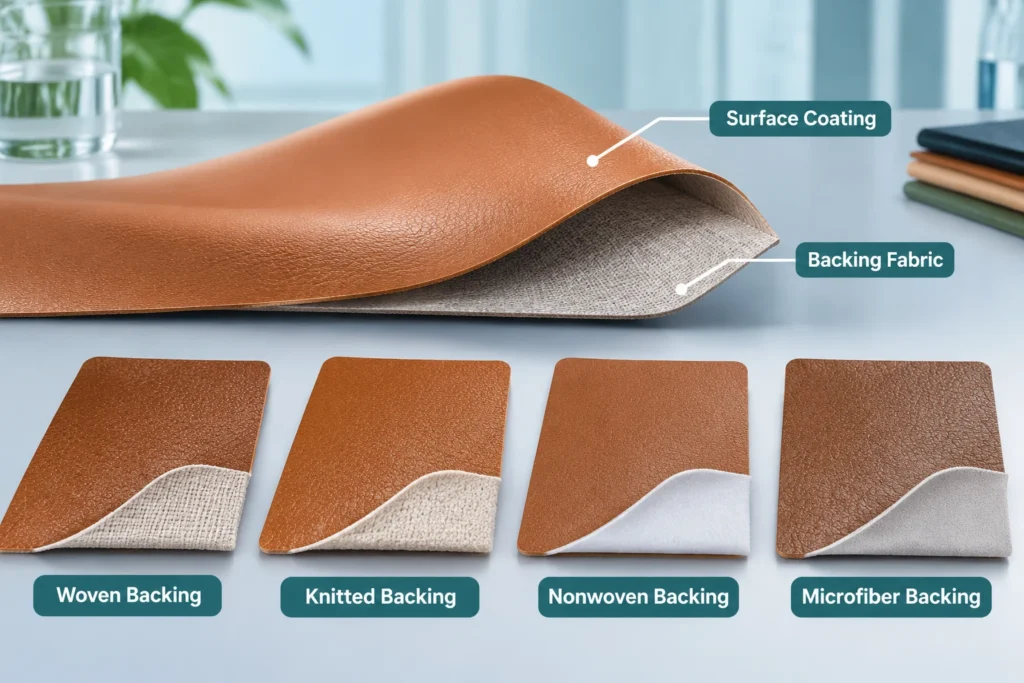
Synthetic leather is a layered material. A typical structure includes a surface coating, a backing fabric, and finishing layers that create color, grain, touch, and functional performance. The coating creates the visible leather-like surface. The backing fabric provides the base strength, support, flexibility, and dimensional behavior underneath that surface.
The backing can be woven, knitted, nonwoven, microfiber, stretch fabric, or a blended construction. Each option changes how the material feels, stretches, tears, sews, wraps around curves, and bonds with the coating. This is why buyers should not approve synthetic leather by appearance alone. The construction underneath the coating can decide whether the final product feels stable, flexible, soft, firm, durable, or easy to process.
Why Backing Fabric Matters in Synthetic Leather
Strength and tear resistance
The backing layer is a major factor in tensile strength, tear resistance, seam holding, edge stability, and punched-hole performance. When a material is pulled, stitched, folded, or stretched over a frame, the backing often carries much of the mechanical load. A strong surface coating cannot fully compensate for a weak base layer.
This is why synthetic leather tensile strength testing should be interpreted with the backing structure in mind. A woven-backed material, a knitted-backed material, and a microfiber-based material may show different results in machine and cross directions. The failure pattern matters as much as the peak number.
Stretch, recovery, and dimensional stability
Backing fabric affects how much the material stretches and whether it returns to shape. A knitted or stretch backing may fit curves more easily, which can help with seat covers, soft upholstery, shoe uppers, and garments. A woven backing may offer better dimensional stability, which can help structured products such as bags, panels, or furniture parts that should not deform easily.
More stretch is not always better. Too much stretch can cause sagging, waves, loose seams, or fitting problems. Too little stretch can make it harder to wrap complex shapes. The correct choice depends on the application, cutting direction, sewing method, foam structure, and final product design.
Softness, drape, and hand feel
Hand feel does not come from the coating alone. Backing weight, fiber type, density, knit structure, and thickness all influence softness, drape, body, and recovery. A lightweight nonwoven backing may feel soft and flexible. A stable woven backing may feel firmer. A dense microfiber base may provide a fuller, more leather-like touch.
Buyers should evaluate hand feel on the real product, not only on a small flat swatch. A material that feels soft in the hand may wrinkle or sag on a sofa cushion. A firm material may work well for a bag panel but feel too rigid for a garment. Backing fabric helps define those application limits.
Coating adhesion and delamination risk
Backing fabric also affects how well the coating bonds to the base layer. Fiber surface, density, pretreatment, coating penetration, primer, lamination method, and curing conditions all influence bonding. If the interface is weak, the surface can blister, peel, or delaminate even when the top coating looks attractive.
The guide to coating adhesion and peel strength explains why buyers should check the bond between coating and backing, not just surface hardness. A good backing should support the coating without causing early separation during flexing, heat, cleaning, or humidity exposure.
Common Types of Synthetic Leather Backing Fabric
Woven backing
Woven backing is made by interlacing yarns in two directions. It is usually chosen when buyers need dimensional stability, controlled stretch, and stronger structure. Because the yarns are organized in warp and weft directions, the material may behave differently depending on cutting direction.
Woven-backed synthetic leather can be useful for bags, structured upholstery, furniture panels, trim panels, and products that need better shape retention. Its possible limitation is that it may feel firmer or less flexible than knitted or soft nonwoven backing. Buyers should check fabric weight, density, direction behavior, and how the coating bonds to the woven surface.
Knitted backing
Knitted backing is generally more flexible and stretchable than woven backing. It can help synthetic leather wrap around curves and fit padded shapes. This can be useful for seat covers, garments, shoe uppers, soft upholstery, and applications where flexibility is important.
The main risk is dimensional control. If the knit stretches too much or recovers poorly, the finished product may show waves, wrinkles, seam movement, or loose fitting. Buyers should check stretch direction, recovery, seam stability, and whether the material remains stable after bending, sitting pressure, or product assembly.
Nonwoven backing
Nonwoven backing is made from fibers bonded together rather than woven or knitted into a yarn structure. It can be soft, light, and cost-flexible. It may be suitable for decorative goods, light upholstery, garments, bags, and products where a soft hand feel or lower weight is important.
However, nonwoven backing varies widely. Some grades may have limited tear resistance, edge stability, or long-term load performance. The buyer should not assume all nonwoven backings are weak or all are soft. Fiber type, bonding method, weight, density, and coating penetration can change the final result.
Microfiber backing
Microfiber backing uses a dense synthetic fiber structure that can provide strong support, durability, and a more leather-like body. It is often used in higher-performance synthetic leather where buyers need better tear resistance, abrasion performance, shape stability, and hand feel. For many applications, microfiber leather is selected because the base structure contributes to durability as much as the surface coating does.
Microfiber backing is commonly considered for automotive interiors, sofas, shoes, bags, and premium upholstery. Its limitation is usually cost and specification control. Buyers should still verify thickness, surface finish, coating adhesion, softness, and actual application performance rather than assuming that every microfiber-backed material is automatically suitable for every product.
Woven vs Knitted vs Nonwoven vs Microfiber Backing
The best backing type depends on the product. The table below summarizes the common differences without treating any one option as universally superior.
| Backing type | Main strength | Possible limitation | Common applications |
|---|---|---|---|
| Woven backing | Stability, strength, controlled stretch | Less flexible, may feel firmer | Bags, structured upholstery, panels |
| Knitted backing | Stretch, softness, curve fitting | May deform if poorly controlled | Seat covers, garments, shoes |
| Nonwoven backing | Softness, lightweight, cost flexibility | Lower tear or edge stability in some grades | Light upholstery, decorative goods |
| Microfiber backing | Durability, leather-like structure, strong support | Usually higher cost | Sofas, automotive, shoes, premium bags |
This comparison should be used as a selection guide, not a fixed ranking. A high-quality knitted backing may perform better than a poor woven backing for a curved seat cover. A microfiber base may be excellent for a car seat but unnecessary for a low-stress decorative panel. The right answer depends on the coating, thickness, target product, test requirements, budget, and production method.
How Backing Fabric Affects PU Leather and Microfiber Leather
PU leather is often made with a polyurethane coating applied to a woven, knitted, nonwoven, or other textile base. This means two PU leathers can look similar on the surface but feel and perform differently because the backing is different. One may be stable and firm for bags, while another may be softer and more elastic for upholstery or garments.
Microfiber leather uses a different structure. Instead of relying only on a general fabric base, it usually has a dense microfiber matrix that gives the material more body, strength, and leather-like support. This is one reason buyers often compare microfiber leather vs PU leather when durability, hand feel, and long-term performance matter.
However, the comparison should still be application-specific. A premium PU construction with the right backing may be suitable for many products. A microfiber material must still be checked for coating quality, thickness, softness, colorfastness, flexing, and adhesion. Material names help narrow the options, but construction data and sample testing should make the final decision.
Which Backing Fabric Should Buyers Choose by Application?
Backing choice should begin with the end product. A sofa, bag, shoe, car interior, garment, and medical chair do not stress the material in the same way. The backing must support the real cutting, sewing, wrapping, bending, sitting, cleaning, and storage conditions of the finished product.
| Application | Key backing requirement | Suggested direction |
|---|---|---|
| Sofa upholstery | Support, softness, abrasion, seam stability | Woven, knitted, or microfiber depending on grade |
| Automotive interiors | Dimensional stability, heat aging, low odor, coating stability | Microfiber or stable woven-backed constructions |
| Bags and luggage | Shape retention, tear strength, edge stability | Woven or microfiber backing |
| Shoes | Flexing, softness, tear resistance, shape recovery | Knitted, microfiber, or engineered backing |
| Garments | Drape, softness, light weight | Knitted or soft nonwoven backing |
| Medical/public seating | Cleaning, coating adhesion, seam strength, durability | Stable woven or microfiber-backed materials |
For high-contact applications, buyers should evaluate backing together with coating, finish, and tests. For example, sofa upholstery needs comfort and repeated sitting stability. Automotive trim needs dimensional control and heat-aging behavior. Bags need edge strength and shape retention. Shoes need flexing and recovery. No single backing fabric solves every product requirement.
Buyer Checklist: What to Ask Before Ordering
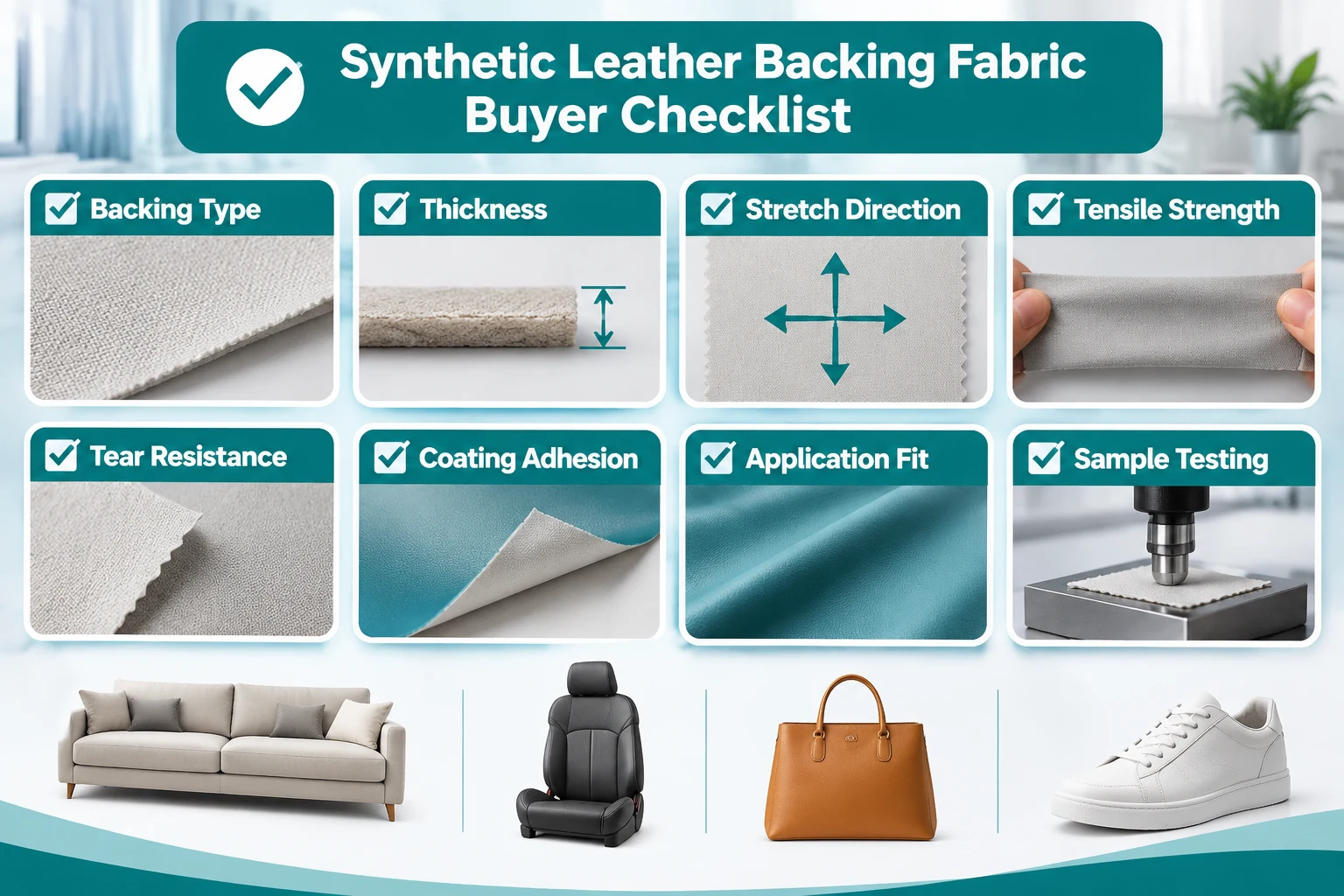
Before ordering synthetic leather, buyers should request more than a color card. The backing should be part of the specification and sample approval process.
- What backing type is used: woven, knitted, nonwoven, microfiber, or blended?
- What is the backing weight and thickness?
- What is the stretch direction and recovery behavior?
- What tensile and tear data are available?
- How does the backing affect coating adhesion or peel strength?
- Is the material tested after flexing, heat, humidity, or cleaning when relevant?
- Is the sample from the same construction planned for bulk production?
- Has the finished product design been considered, not only the flat swatch?
These questions help prevent a common sourcing problem: approving a beautiful surface that does not match the real product structure. A useful sample should represent the final backing, coating, thickness, finish, color, and processing method planned for bulk production.
Common Mistakes When Selecting Backing Fabric
Choosing only by surface grain
Surface grain is easy to compare, but it does not prove strength, stretch, seam stability, or coating adhesion. Two materials can share the same embossing pattern and still have different backings, different tensile behavior, and different product suitability.
Ignoring stretch direction
Direction matters. Woven fabrics often behave differently along warp and weft. Knitted and stretch backings may also have preferred stretch directions. If the cutting direction ignores the main load path, the finished product may sag, wrinkle, distort, or fail at seams.
Using one backing for every application
A backing that works for a soft shoe upper may not be ideal for a structured bag. A backing that works for a bag panel may feel too firm for garments. A material that works for a sofa side panel may not be strong enough for a high-contact seat cushion. Application matching is essential.
Comparing prices without comparing construction
Lower prices may come from a lighter backing, weaker bonding, thinner coating, or less stable structure. That may be acceptable for some low-stress products, but it can create higher costs through returns, cutting waste, warranty claims, or product failure. Price comparison should include construction and test data.
FAQ
What is synthetic leather backing fabric?
It is the base layer under the surface coating that gives synthetic leather strength, support, stretch control, tear resistance, and sewing stability.
Which backing fabric is best for synthetic leather?
There is no single best type. Woven, knitted, nonwoven, and microfiber backing each fit different applications, hand-feel requirements, strength targets, and cost levels.
Is woven backing stronger than knitted backing?
Woven backing usually offers better dimensional stability and strength, while knitted backing offers more stretch and flexibility. The right choice depends on the final product.
Why does backing fabric affect coating adhesion?
Fiber structure, surface treatment, coating penetration, lamination, and curing influence how strongly the coating bonds to the backing layer.
What backing is used in microfiber leather?
Microfiber leather typically uses a dense microfiber base that provides stronger structure, leather-like feel, and better durability than many ordinary fabric-backed materials.
What should buyers check before ordering synthetic leather?
Buyers should check backing type, weight, thickness, stretch, tensile strength, tear resistance, coating adhesion, sample performance, and application fit before bulk production.
Conclusion: Choose Backing Fabric by Real Product Requirements
Synthetic leather performance depends on more than the surface coating. Backing fabric affects strength, stretch, softness, tear resistance, sewing behavior, coating adhesion, and finished product stability. Woven backing, knitted backing, nonwoven backing, and microfiber backing all have useful roles, but they should be selected according to application, coating system, thickness, testing, and production method.
If you need PU leather, microfiber leather, or custom synthetic leather for sofas, automotive interiors, bags, shoes, medical seating, or other applications, Taite can help compare backing type, coating system, thickness, hand feel, adhesion, tensile performance, and sample behavior before bulk production. Contact us to request samples or discuss a custom material solution for your project.