

Synthetic leather tensile strength is a core indicator of whether a material can survive pulling, stitching, stretching, and repeated use without failing. A thick-looking surface alone says very little about real durability. The backing fabric, coating formulation, lamination interface, and elongation behavior all influence how a synthetic leather performs under load. This article explains tensile strength, tear resistance, and elongation; outlines practical test procedures; and shows how to interpret common failure patterns.
What Does Synthetic Leather Tensile Strength Mean?
Synthetic leather tensile strength describes the maximum pulling load or stress a specimen can withstand before it breaks under controlled testing. It is a useful baseline for load-bearing capability, but it is not a complete durability verdict. A material may have high tensile strength and still perform poorly at a seam, at a cut edge, or after repeated flexing.
For meaningful comparisons, test reports should identify material construction, thickness, backing type, test direction, specimen conditioning, and the method used. Comparing a heavy woven-backed material with a lightweight knit-backed material by one number alone is rarely useful.
Tensile strength vs. elongation at break
Tensile strength answers “how much load can the material take?” Elongation at break answers “how far can it stretch before it fails?” Both matter. A very strong but low-elongation coating can become brittle; a highly extensible material can feel flexible but lack the stability needed for a structured product. In a complete synthetic leather tensile strength report, these two values should be interpreted together rather than as isolated pass/fail figures.
Tensile strength vs. tear strength
Tear strength measures resistance to a growing cut or notch. Once a small cut exists, stress concentrates at the cut tip, so tensile strength alone cannot predict whether the crack will run. For edges, punched holes, seams, and stitched areas, tear resistance is often equally important.
How to Test Synthetic Leather Tensile & Tear Strength
A repeatable method matters more than chasing a universal “good” value. The correct method and acceptance limit should follow the material construction, customer specification, end use, and target market.
Prepare representative specimens
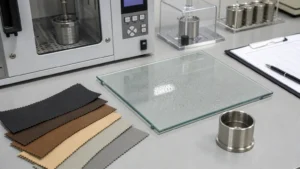
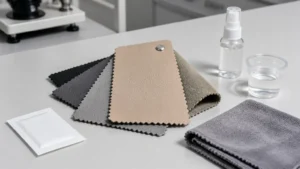
Cut specimens from several positions across the roll, not just one convenient corner. Prepare both machine-direction and cross-direction specimens because backing structures frequently behave differently by direction. Record thickness, coating side, backing construction, and any pre-conditioning temperature or humidity.
Run a tensile test
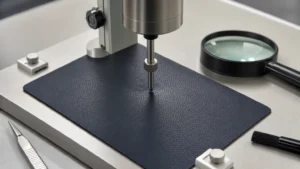
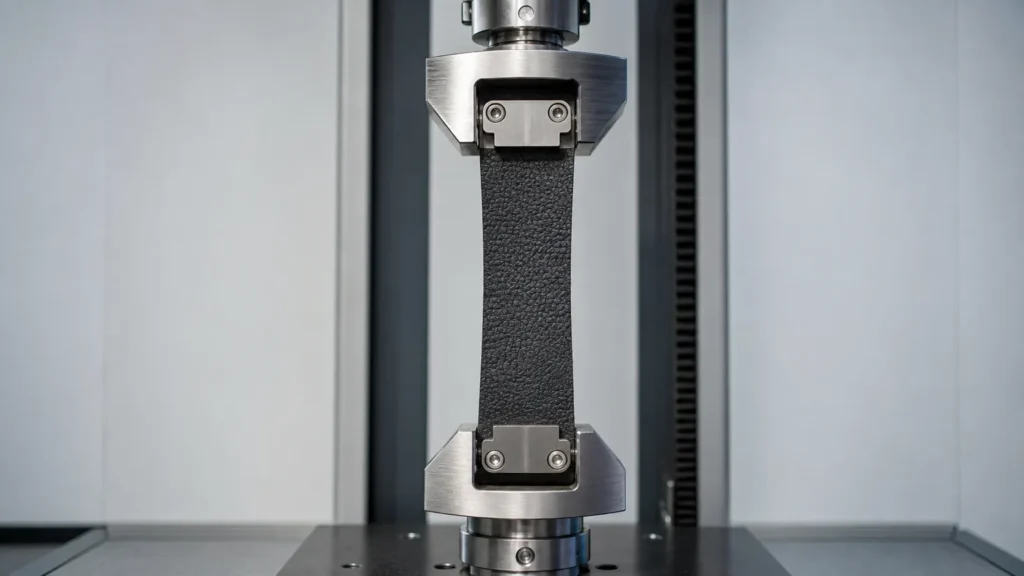
Mount the test strip in a calibrated tensile tester with consistent grip spacing and test speed. Pull until the specimen fails, then record maximum force, elongation, and failure location. Did the backing rupture, did the coating crack, or did layers separate? That observation can be more valuable than the peak number itself.
Run a tear-resistance test
Tear methods use a defined cut, slit, or shaped specimen so the machine measures the force required to extend a controlled tear. Tongue and trapezoid-style procedures are common concepts for textile-backed materials, but the selected method must match the relevant specification. Do not apply one procedure to every synthetic leather construction without confirming suitability.
Use relevant standards correctly
Standards make results comparable across batches and laboratories; they do not create a single pass/fail target for every product. For coated fabrics, methods such as ASTM D751 can provide a reference framework for breaking strength testing. Final methods and limits should always be defined by the actual application and customer requirement.
How to Read the Results: 4 Failure Patterns
The point of a test is not only to receive a number. The way a specimen fails reveals where the material construction needs attention.
| Observed Failure | Likely Technical Cause | What to Investigate |
|---|---|---|
| Backing ruptures first | Base fabric is limiting | Yarn, weave or knit structure, fabric weight |
| Coating cracks first | Coating is too brittle | Formulation, thickness, low-temperature flexibility |
| Layers separate | Adhesion system is weak | Primer, bonding process, cure condition |
| Warp/weft result gap | Directional structure imbalance | Cutting direction and end-use load path |
Base fabric rupture
If the backing fails first, the limiting factor is usually yarn strength, fabric weight, or weave/knit density. A stronger surface coating will not solve a weak backing. This is especially relevant when a finished product transfers load through seams or handles.
Coating crack before fabric failure
If the coating cracks while the backing is intact, investigate coating formulation, plasticization, cure condition, and cold flexibility. The material may pass a room-temperature pull test but become brittle after aging or low-temperature exposure.
Delamination between coating and backing
Layer separation points to the bonding system rather than the base fabric alone. Check primer selection, coating penetration, lamination pressure, cure profile, and surface preparation. Delamination can also become visible after humid-heat aging, which is why it should be considered together with hydrolysis resistance testing.
Direction imbalance: warp vs. weft
A large difference between machine and cross directions may be normal for a directional backing, but it must be accounted for during product design. Align the stronger direction with the primary load path where possible, and verify that cutting patterns do not place weak direction across a highly stressed seam.
What Affects Synthetic Leather Tensile & Tear Strength?
Improving synthetic leather tensile strength is a construction problem, not a single-material switch. These factors work together.
Backing fabric structure and weight
Woven, knitted, and microfiber non-woven backings distribute load differently. Higher yarn strength, denser construction, and suitable weight can improve strength, but they may affect drape, thickness, and cost.
Coating formulation and thickness
Coating layers must balance toughness, flexibility, and adhesion. Adding thickness can increase body, but excessive or poorly formulated coating may crack before the backing reaches its potential.
Lamination and adhesion design
The interface between coating and backing must transfer stress without peeling. Good primer chemistry, curing, and process consistency are essential for reliable tear and tensile behavior.
Temperature, humidity, and aging
Performance changes after heat, moisture, UV exposure, and flexing. A complete technical evaluation should connect tensile testing with abrasion testing, hydrolysis testing, and the color-fastness and yellowing tests relevant to the intended environment.
Choosing the Right Test Target by Application
There is no responsible universal target for synthetic leather tensile strength. The correct threshold depends on how the finished product transfers load and how it ages in service.
Sports equipment
Sports products need a balanced combination of tensile, tear, flex, and seam performance because repeated impact and stretching concentrate load at joints. Technical material selection should consider the product’s actual load paths, not just an attractive surface finish.
Bags and luggage
For bags, local damage at edge folds, stitching, punched holes, and handle attachments can matter more than broad-panel tensile strength. Tear resistance and backing integrity deserve close attention. Synthetic leather tensile strength remains valuable as a baseline, but it should be evaluated with these local stress points in mind.
Furniture upholstery
Furniture materials experience broad tension during upholstery plus repeated seating and flexing. Backing stability, coating crack resistance, and long-term flex performance should be evaluated together rather than isolated into a single pull test.
Frequently Asked Questions
What is a good tensile strength for synthetic leather?
A suitable result depends on the backing, thickness, end use, and specified test method. Instead of relying on one universal number, define a target using the product’s load path and the relevant customer or application requirement.
Is tear strength more important than tensile strength?
Neither replaces the other. Tensile strength measures whole-specimen pulling capacity, while tear strength measures resistance to an expanding cut. Products with seams, holes, and exposed edges often need both.
Why does synthetic leather crack during a tensile test?
Cracking can result from a brittle coating formulation, insufficient flexibility, aging, poor plasticization, excessive coating thickness, or low-temperature exposure. The failure location helps identify whether the coating or backing is the limiting layer.
How do backing fabrics affect synthetic leather strength?
Backing fabric structure, yarn strength, density, and weight strongly influence tensile and tear behavior. Directional backings can also produce different values in machine and cross directions, which should be considered during cutting and design.