

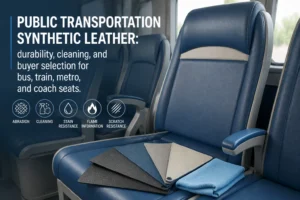
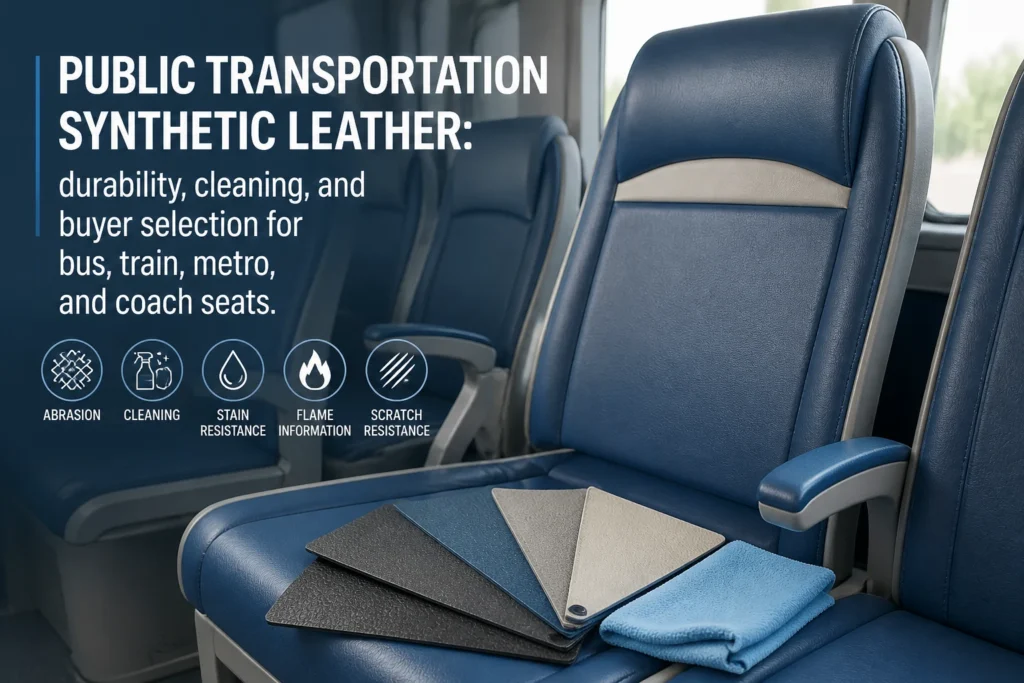
Public transportation synthetic leather can be suitable for bus seats, train seats, metro seating, coach interiors, station seating, and other high-traffic public upholstery when the material is specified for frequent passenger use. Buyers should not choose public transport upholstery only by color or leather-like texture. They need to confirm abrasion resistance, cleaning compatibility, stain resistance, scratch visibility, backing strength, surface finish, odor, flame-related documentation, color consistency, and sample performance before approving materials for bus, rail, or transit seating projects.
Public transportation seating is different from ordinary home furniture. Seats may face thousands of passenger contacts, regular cleaning, bags, belts, dust, food stains, clothing friction, and maintenance routines. A material that looks good on a showroom chair may not be suitable for a bus, coach, metro, train, or public waiting area unless it has been checked against the real use environment.
This guide explains how buyers can evaluate synthetic leather for public transport seats without relying on appearance alone. It focuses on practical selection factors: abrasion, cleaning, stain resistance, scratch visibility, flame-related information, backing, odor, surface finish, color consistency, and sample validation.
What Is Public Transportation Synthetic Leather?
Public transportation synthetic leather is a leather-like engineered material selected for bus seats, coach seats, train seats, metro seating, tram interiors, station seating, and other high-traffic public upholstery. It may be based on PU, microfiber, PVC/vinyl, silicone, specialty coatings, or other synthetic structures depending on the project requirement.
The main difference from ordinary furniture upholstery is the use intensity. Public seats are used by many passengers, cleaned often, and exposed to bags, clothing, dust, footwear, service tools, and repeated friction. For this reason, buyers should evaluate material structure, surface finish, backing, cleaning compatibility, and project documentation before approving samples.
Why Public Transport Seats Need Different Upholstery Materials
High passenger turnover and repeated friction
Bus, coach, train, and metro seats may experience repeated sliding, sitting, standing, cleaning, and contact with clothing or luggage. This is why abrasion resistance is usually one of the first issues buyers discuss. A Martindale abrasion test can help explain repeated wear behavior, but buyers should still match the requirement to the actual vehicle type and replacement plan.
Frequent cleaning and stain exposure
Public seats may contact drinks, dust, food residue, sweat, clothing dye, hand oils, and cleaning agents. Easy cleaning matters because operators need practical maintenance, not only a good-looking seat on the first day. The synthetic leather stain resistance test article explains why stain behavior should be checked before bulk orders, especially for light colors or high-use routes.
Flame-related requirements for public interiors
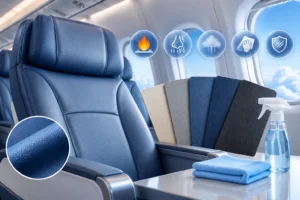
Many public interior projects require flame-related information, internal review, or project-specific documentation. This does not mean every synthetic leather automatically fits every transport project. Buyers should ask what information is available for the exact material, backing, finish, thickness, and color being considered. A flame retardant synthetic leather test can help buyers understand the topic, but the applicable requirement should always be confirmed for the vehicle type, operator, or project.
Odor and passenger comfort
Public vehicles may be enclosed or semi-enclosed spaces. A material with strong packaging odor or poor ventilation behavior can affect passenger comfort, especially in warm cabins or newly refurbished interiors. Buyers should review odor after packaging, storage, heat exposure, and cleaning, rather than judging only from a fresh swatch.
Key Requirements for Bus and Train Seat Upholstery
The following checklist helps buyers organize material discussions with suppliers. It does not replace project-specific review, but it prevents choosing transit upholstery only by color, grain, or hand feel.
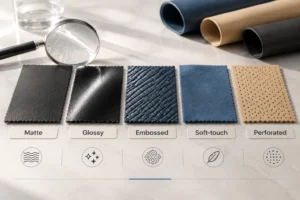
Sample review should also include the final seat design. A flat swatch may perform differently after sewing, stretching, wrapping around foam, or being installed on a curved seat shell. If the transit project uses perforation, embossing, contrast stitching, piping, or light colors, those details should be tested on the real sample construction before fleet-wide approval.
| Requirement | Why it matters in public transportation | What buyers should ask |
|---|---|---|
| 耐摩耗性 | Heavy daily passenger traffic | What wear test or internal requirement is used? |
| Stain resistance | Drinks, dust, food, sweat, dye transfer | How easy is the surface to wipe after common stains? |
| Cleaning compatibility | Frequent public cleaning routines | Which cleaners are safe for repeated use? |
| Scratch resistance | Keys, bags, belt buckles, luggage | Are visible scuffs acceptable under cabin lighting? |
| Flame information | Public interior material review | What flame-related documentation is available for this project? |
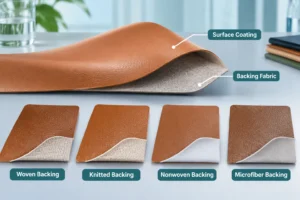
| Backing strength | Sewing, pulling, installation, seat shape | Which backing structure fits the seat design? |
| Odor control | Passenger comfort in enclosed vehicles | What happens after packaging, storage, and heat exposure? |
| Color consistency | Fleet replacement and refurbishment | Can color and texture stay consistent across batches? |
Sample review should include the final seat construction whenever possible. A flat swatch may look acceptable, but the finished seat can include curves, foam, seams, piping, adhesive, and edge tension. These details can affect appearance, sewing, cleaning, and long-term wear.
PU, Microfiber, PVC, and Specialty Options for Public Seating
PU leather for flexible seating upholstery
PUレザー can be considered when a project needs flexible seating upholstery, controlled texture, color options, and cost balance. For public transportation use, buyers should check not only softness, but also coating stability, cleaning response, backing, odor, and sample durability under the expected use condition.
Microfiber leather for stronger structure
マイクロファイバー・レザー may be considered when the buyer wants stronger structure, tighter backing, better hand feel, or improved durability for high-contact seating. It can be relevant for coach seats, train seats, metro seats, and premium public interiors, but the final choice still depends on cleaning, weight, cost, flame-related documentation, and installation needs.
PVC/vinyl and specialty coatings for easy cleaning
PVC/vinyl and specialty coated synthetic leather may be considered when cleaning, stain resistance, surface toughness, or low maintenance is a priority. However, no material category should be treated as automatically best. Buyers should compare actual samples under the same cleaning, bending, wear, and color conditions expected in the project.
Why ordinary home upholstery may not be enough
Home upholstery may not need to survive the same passenger turnover, cleaning frequency, replacement planning, or public interior documentation review. A furniture material can look attractive but still be unsuitable for bus or train seats if the backing, surface, cleaning response, odor, or color consistency does not match the project.
Cleaning and Maintenance Considerations
Daily wiping and scheduled cleaning
Public transport upholstery may be wiped daily or cleaned on a fixed schedule. The material should be checked with the actual cleaning method expected by the operator. Buyers should ask whether repeated wiping may affect color, gloss, hand feel, coating stability, or surface tackiness.
Stain and dye transfer control
Passenger clothing, bags, drinks, dust, oil, and sweat can affect seat appearance. Light colors, smooth surfaces, and high-gloss finishes may show staining or dye transfer more clearly. Buyers should review stain behavior on the final color and finish, not only on a generic black or dark sample.
Scratch and scuff visibility
Luggage, keys, metal buckles, shoe edges, and cleaning tools may create scratches or scuffs. A surface can pass repeated wear review but still show bright marks under vehicle lighting. For visible panels and seat backs, scratch visibility should be checked together with abrasion and stain resistance.
How to Select Synthetic Leather for Bus, Coach, and Train Seats
Material selection should begin with the vehicle type and the seat part. City buses, long-distance coaches, metro trains, regional trains, trams, and public waiting areas may have different requirements for seat shape, cleaning, passenger traffic, color, replacement, and material documentation.
- Define the vehicle type: city bus, coach, train, metro, tram, station seating, or public waiting area.
- Confirm seat shape, foam, stitching, piping, and installation method.
- Clarify abrasion expectation and replacement cycle.
- Confirm cleaning chemicals and cleaning frequency.
- Ask what flame-related documentation is needed for the project.
- Review stain resistance and dye transfer risk.
- Check scratch and scuff visibility under vehicle lighting.
- Select coating type and backing structure.
- Confirm color and texture consistency across batches.
- Test real samples before fleet-wide approval.
The handoff between design, purchasing, production, and maintenance teams should be clear. Design may focus on color and texture, while maintenance may focus on cleaning and stain behavior. Production teams may focus on sewing, backing, and installation. If these requirements are not aligned early, the material may pass visual approval but create issues during operation.
Common Mistakes Buyers Should Avoid
Choosing by color only
Public transport seats often need colors that hide dirt and match fleet identity, but color alone does not prove abrasion resistance, stain resistance, cleaning compatibility, or backing strength. Buyers should treat color as one part of the specification, not the whole specification.
Assuming one test result covers every transit project
Different cities, operators, seat designs, cleaning routines, and vehicle types may have different material expectations. A result from one construction, color, backing, or finish should not automatically be applied to every project. Buyers should confirm what the data actually covers.
Ignoring cleaning chemicals
Cleaning is one of the most common sources of public seating material problems. Incompatible cleaners can cause discoloration, gloss change, tackiness, stiffness, or surface wear. The expected cleaning process should be discussed before sample approval.
Using ordinary furniture upholstery for bus or train seats
Furniture upholstery and public transport upholstery may look similar, but they are used differently. Public seats need to be reviewed for repeated passenger friction, cleaning, flame-related information, backing, odor, color consistency, and batch replacement. A home furniture material should be re-checked before use in buses or trains.
FAQ
What is public transportation synthetic leather?
It is synthetic leather selected for bus seats, train seats, metro seating, coach interiors, station seating, and other high-traffic public upholstery.
Is synthetic leather suitable for bus and train seats?
It can be suitable when specified for frequent passenger use and checked for abrasion, cleaning, stain resistance, scratch visibility, backing, odor, color consistency, and flame-related project information.
Why is abrasion resistance important for public transport seats?
Public seats face repeated passenger movement, clothing friction, bags, luggage, and cleaning, so surface wear should be checked before bulk production.
Does public transportation synthetic leather need flame retardant information?
Many public interior projects require flame-related information or documentation. Buyers should confirm the exact requirement for the vehicle type, operator, or project.
Is PU or microfiber better for public transportation seats?
PU may offer flexibility and cost control, while microfiber may offer stronger structure and premium feel. The better option depends on the project’s durability, cleaning, backing, weight, budget, and documentation needs.
What should buyers check before ordering transit seat upholstery?
Buyers should check abrasion, stain resistance, cleaning compatibility, scratch visibility, flame-related documentation, backing strength, odor, color consistency, and sample performance.
Final Buyer Takeaway
Public transportation synthetic leather should be selected through real vehicle use conditions, not appearance alone. Buyers need to consider passenger turnover, abrasion, cleaning, stain resistance, flame-related project information, backing, odor, surface finish, color consistency, and sample performance before approving materials for buses, trains, coaches, metros, or public seating areas.
If you are developing bus seats, train seats, metro seating, coach interiors, station seating, or other high-traffic public upholstery, Taite can help compare PU, microfiber, PVC/vinyl, and specialty synthetic leather options based on your cleaning routine, backing, color, surface finish, flame-related documentation needs, and sample testing requirements.