

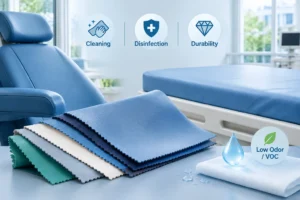
Medical synthetic leather is a coated upholstery material used for medical beds, treatment chairs, dental chairs, examination tables, waiting-room seating, rehabilitation equipment, and other healthcare or public-use surfaces. Buyers should not choose it by softness or appearance alone. The material should be evaluated for cleaning response, disinfectant compatibility, alcohol resistance, stain resistance, abrasion, hydrolysis, odor, VOC direction, coating adhesion, and optional antimicrobial performance. For medical upholstery, the right material depends on how often the surface will be wiped, which cleaners are used, whether skin contact is frequent, and what durability level the finished product requires.
Medical and healthcare upholstery is different from ordinary furniture upholstery. A chair in a clinic may be cleaned many times each day. A medical bed cover may contact moisture, body oils, disinfectant wipes, and frequent bending. A dental chair or treatment table may face repeated rubbing, sweat, and cleaning chemicals. If the surface coating is not stable, the material may lose gloss, transfer color, feel sticky, crack, or peel long before the structure underneath fails.
What Is Medical Synthetic Leather?
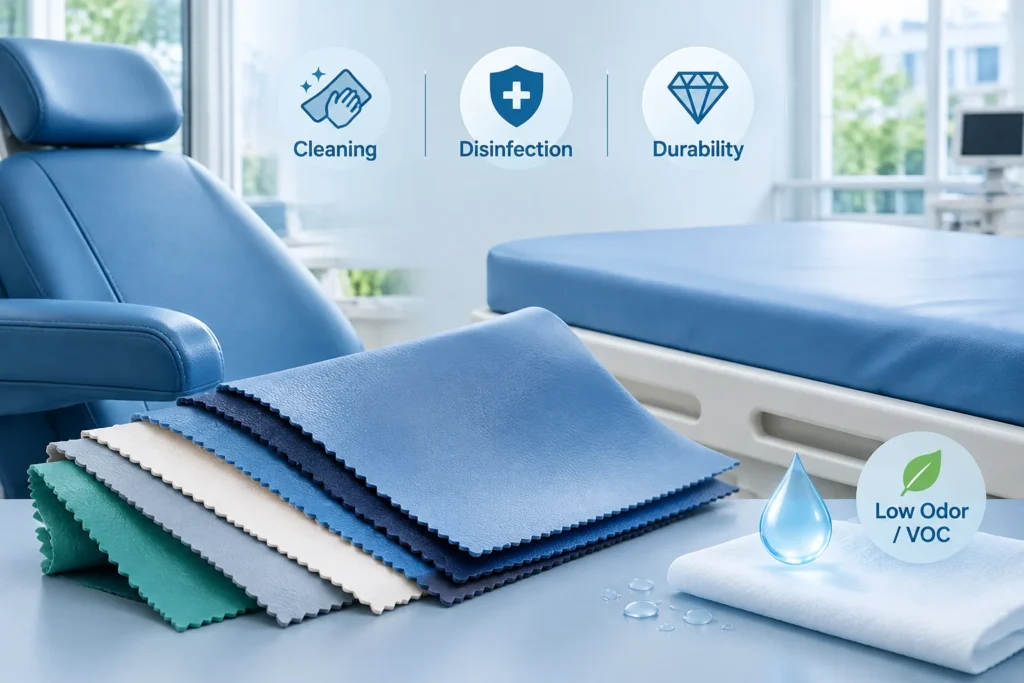
This healthcare upholstery material is not one single formula. It is a category of coated leather-like materials used where healthcare, public seating, or easy-clean performance matters. Depending on the project, it may be based on PU leather, water-based PU, silicone leather, microfiber leather, or another coated construction. The best option depends on the required cleaning method, comfort level, durability target, appearance, budget, and safety expectations.
For medical use, the visible grain and soft hand feel are only the starting point. A buyer also needs to understand the surface topcoat, backing, thickness, coating adhesion, color stability, odor direction, and compatibility with cleaning procedures. A material that looks good on a sample card may behave differently after daily wiping, disinfectant exposure, heat, humidity, and repeated sitting.
Why Medical Upholstery Needs Different Material Requirements
Healthcare and public-use surfaces face more demanding cleaning conditions than many home or fashion products. Medical upholstery may be wiped with damp cloths, mild cleaners, alcohol-based products, disinfectant wipes, or other approved cleaning systems. It may also face sweat, skin oils, body contact, moisture, abrasion, and repeated movement.
This is why a generic “easy-clean” claim is not enough. The buyer should know which cleaner is used, how often it is used, how long the cleaner stays on the surface, how hard the surface is wiped, and what appearance change is acceptable after repeated cycles. Without these details, two materials can both be described as easy-clean while performing very differently in real healthcare environments.
Medical upholstery also needs a balance between hygiene, comfort, and durability. A very hard surface may clean easily but feel uncomfortable. A very soft surface may feel premium but fail under repeated disinfection. The right medical synthetic leather should match the actual use case instead of chasing one isolated property.
Key Performance Factors for Medical Synthetic Leather
Cleaning and Disinfection Compatibility
Cleaning compatibility is one of the first questions for healthcare upholstery materials. Medical surfaces may be wiped every day, and in some settings they may be cleaned many times per shift. The material should be tested against the actual cleaning products used in the project, not only against water.
For practical sourcing, buyers can use the guide on safe cleaning and disinfection for synthetic leather as a related reference. The key idea is simple: alcohol or disinfectant exposure is not automatically safe for every coated surface. The cleaner type, concentration, contact time, wipe cycles, temperature, and drying method all matter.
Alcohol Resistance and Chemical Resistance
Alcohol resistance is not a default feature of every PU or faux leather surface. Some coatings can tolerate occasional wiping, while others may show gloss loss, whitening, color transfer, sticky feel, surface hardening, or cracking after repeated exposure. Chemical resistance should therefore be treated as a defined test requirement.
A useful test should inspect the exact color, grain, surface finish, backing, and thickness that will be used in production. It should also reflect the real cleaning method. A single quick wipe on a dark sample may not reveal the same risk as repeated wipes on a light color or printed grain.
Antimicrobial or Antibacterial Options
Some healthcare or public seating projects may request antimicrobial or antibacterial options. This can be useful when the project requires additional material functionality, but it should not be described as a replacement for regular cleaning and disinfection. Antimicrobial treatment is one part of a broader hygiene strategy, not a standalone solution.
If antimicrobial performance is required, the buyer should confirm how it is tested, whether the effect remains after cleaning, and whether the marketing claim is appropriate for the target market. The guide to antimicrobial synthetic leather is useful for understanding how to specify this feature without overclaiming.
Stain Resistance and Easy-Clean Performance
Medical seating and public upholstery may contact medicine, drinks, lotions, sweat, food, cleaning residue, and body oils. A surface that resists one stain may still be difficult to clean after repeated wiping or after the stain dries. Easy-clean performance should be tested with realistic contaminants and realistic cleaning procedures.
For this reason, a synthetic leather stain resistance test is an important companion to medical upholstery evaluation. Buyers should check whether the stain can be removed, whether the surface gloss changes, whether the color transfers, and whether the coating feels sticky after cleaning.
Abrasion, Flexing, and Coating Adhesion
Medical beds, treatment chairs, waiting-room seats, and rehabilitation equipment all experience repeated body movement. Even when the surface is cleaned properly, friction can slowly weaken the coating. High-contact areas such as armrests, seat edges, backrests, bolsters, and mattress corners need special attention.
Abrasion resistance, flex performance, peel strength, and coating adhesion help show whether the surface will remain stable after use. These properties become more important when cleaning chemicals and friction appear together. A coating that performs well in a simple flat-panel test may fail sooner when folded, stretched, wiped, and rubbed repeatedly.
Odor and VOC Direction
Medical and public indoor spaces are sensitive to odor. A strong smell can create a poor user experience even if the material looks acceptable. Low odor and VOC direction may matter for medical furniture, dental chairs, waiting-room seating, and rehabilitation equipment, especially when the product is installed in enclosed rooms.
Water-based PU, solvent-free PU, silicone leather, and selected microfiber leather systems may be considered depending on the project direction. However, buyers should not rely only on material category names. Packaging, storage time, coating chemistry, adhesives, and finished product construction can all influence odor.
PU Leather, Silicone Leather, or Microfiber Leather for Medical Use?
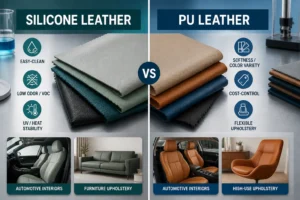
There is no single best material for every medical upholstery project. PU leather, silicone leather, water-based PU, and microfiber leather can all be suitable in different situations. The better choice depends on cleaning frequency, budget, hand feel, color matching, durability, and chemical compatibility.
| Material option | Strengths | Watch points | Better for |
|---|---|---|---|
| PU deri | Cost-effective, soft, many colors and grains | Chemical resistance varies by topcoat | General medical furniture and budget-sensitive projects |
| Water-based PU | Lower odor direction and process positioning | Still needs cleaning and durability tests | Indoor upholstery projects with odor concerns |
| Silicone leather | Easy-clean direction and good surface stability potential | Higher cost; hand feel and color matching need review | High-cleaning, healthcare, public seating, dental or medical chairs |
| Mikrofiber deri | Strong base, durability, premium feel | Surface coating still needs chemical compatibility | Higher-end seating or durable upholstery |
For projects with frequent wiping, stronger easy-clean expectations, or low-odor positioning, silicone leather can be considered as one material direction. Still, buyers should compare sample performance, cost, hand feel, color, surface texture, and the exact cleaning system used in the final environment.
Which Medical and Healthcare Applications Need Synthetic Leather?
Different healthcare products place different stress on the upholstery surface. A medical mattress cover may need moisture and cleaning resistance. A dental chair may need disinfectant compatibility and a comfortable surface. Waiting-room seating may need abrasion and stain resistance because many users contact the same seat every day.
| Uygulama | Main stress | Buyer priority |
|---|---|---|
| Medical bed or mattress cover | Body contact, wiping, moisture | Cleaning response, hydrolysis, low odor |
| Treatment chair | Friction, skin contact, disinfectant wiping | Abrasion, chemical resistance, comfort |
| Dental chair | Repeated cleaning, body oil, disinfectant | Easy-clean, alcohol resistance, coating stability |
| Waiting-room seating | Public use, abrasion, stains | Stain resistance, durability, color stability |
| Rehabilitation equipment | Sweat, flexing, wiping | Flex resistance, coating adhesion, cleanability |
| Public healthcare seating | Frequent use and cleaning | Surface durability and maintenance simplicity |
For medical beds, treatment chairs, waiting-room seating, or healthcare furniture programs, buyers can start from medical product leather fabrics and then narrow the specification by cleaning method, surface finish, thickness, backing, color, and durability target.
Buyer Checklist: How to Specify Medical Synthetic Leather
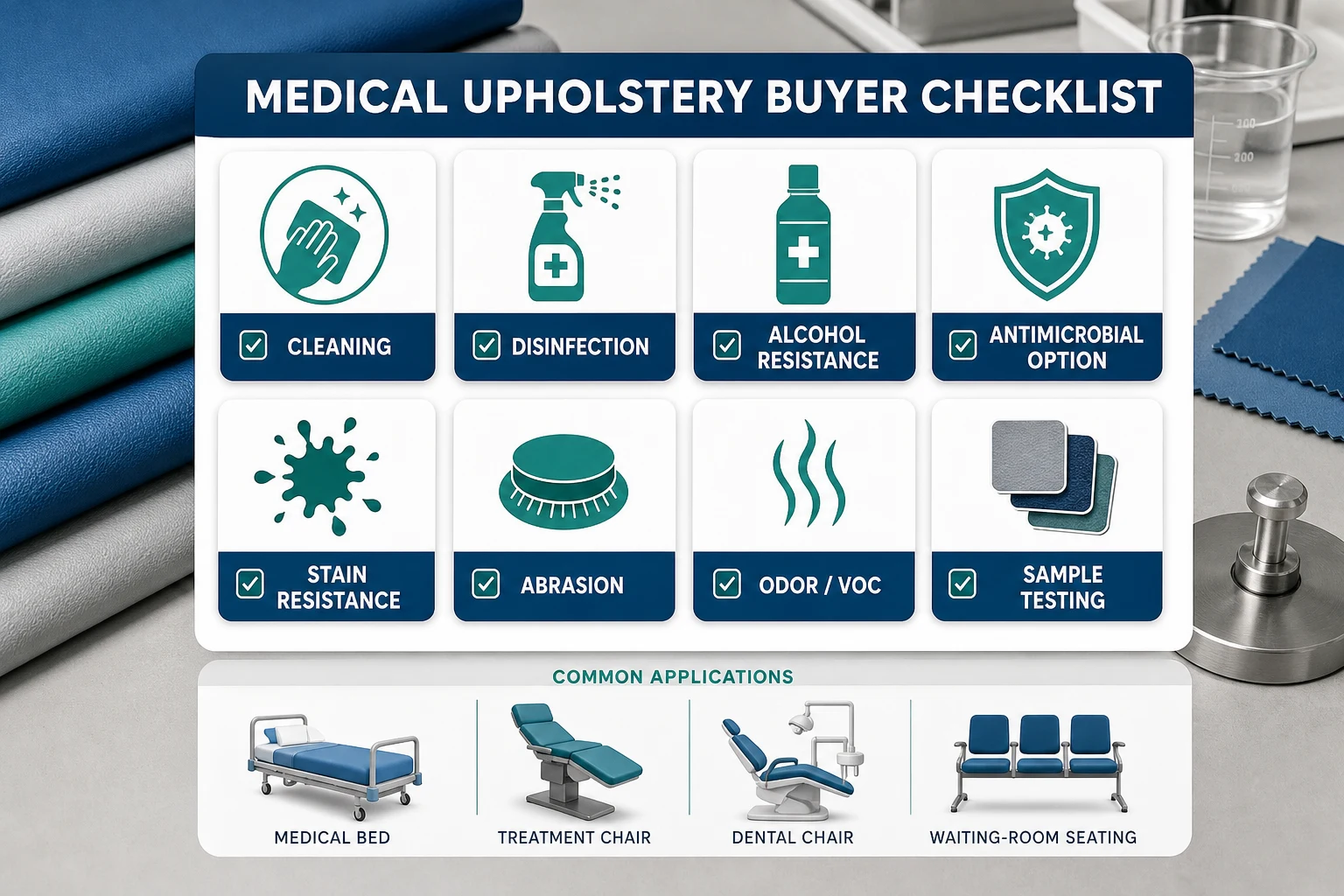
Before approving a healthcare upholstery material, define the exact application. Is it for a medical bed, dental chair, treatment chair, waiting-room seat, rehabilitation equipment, or public healthcare seating? Each use case has different stress conditions. A single material may not be ideal for all of them.
Next, list the cleaning chemicals or disinfectants used in the real environment. Confirm the concentration, contact time, wipe cycles, and drying method. Request stain resistance and easy-clean results. Check abrasion, flexing, coating adhesion, peel strength, odor direction, and sample appearance after cleaning.
Buyers should test the exact color, grain, thickness, backing, and finish planned for production. A white or light beige surface may show stains or color transfer more clearly than a dark surface. A smooth surface may clean differently from a heavy grain. Physical samples should be tested before bulk order.
Common Mistakes When Choosing Medical Upholstery Leather
One common mistake is choosing by softness and grain only. Soft hand feel is useful, but medical upholstery also needs cleaning stability, surface strength, and predictable aging. Another mistake is assuming waterproof means disinfectant-resistant. A surface may repel water but still react poorly to alcohol or disinfectant wipes.
Buyers should also avoid treating antimicrobial performance as a substitute for cleaning. Even if antimicrobial treatment is used, the surface still needs a practical cleaning process. Finally, avoid vague specifications such as “easy clean” or “medical grade” without defined tests, chemicals, wipe cycles, and acceptance criteria.
FAQ
What is this healthcare upholstery material?
It is a coated upholstery material used for medical beds, treatment chairs, dental chairs, waiting-room seating, and other healthcare or public-use surfaces.
What should buyers check before choosing medical upholstery?
Buyers should check cleaning response, disinfectant compatibility, alcohol resistance, stain resistance, abrasion, flexing, odor, VOC direction, coating adhesion, and sample performance.
Is PU leather suitable for medical upholstery?
PU leather can be suitable for some medical upholstery projects if the topcoat, cleaning resistance, durability, and chemical compatibility meet the project requirements.
Is silicone leather better for healthcare seating?
Silicone leather can be a strong option for easy-clean and high-cleaning applications, but buyers should still compare cost, hand feel, color, surface requirements, and test data.
Does medical synthetic leather need antimicrobial treatment?
Not always. Antimicrobial treatment may be useful for specific projects, but it does not replace proper cleaning and disinfection procedures.
Can medical synthetic leather be cleaned with alcohol?
Only if the specific material has been tested or approved for alcohol contact. Buyers should define alcohol concentration, contact time, and wipe cycles before approval.
Conclusion: Choose Medical Synthetic Leather by Use Conditions, Not Labels
Healthcare upholstery should be selected according to the cleaning method, disinfectant exposure, contact frequency, comfort requirement, stain risk, odor expectation, durability target, and finished product design. A material that works for a simple waiting-room chair may not be enough for a dental chair or medical bed cover that is cleaned more often.
If you need synthetic leather for medical beds, treatment chairs, dental chairs, waiting-room seating, public upholstery, or healthcare equipment, Taite can help compare cleaning response, alcohol resistance, antimicrobial options, stain resistance, surface durability, odor direction, backing, thickness, color, and sample performance before bulk production. Contact us to request samples or discuss a custom medical upholstery material solution.