

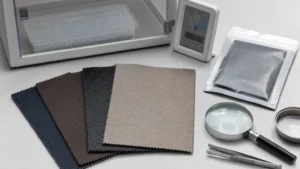
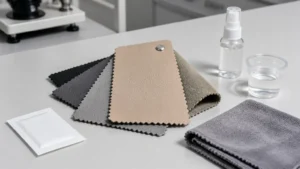
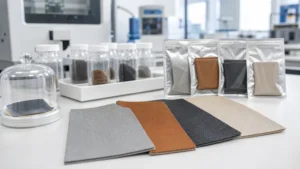

Understanding how synthetic leather is made explains why two materials that look identical on a sample card can perform completely differently in use. Synthetic leather is not formed in a single step — it is built up through a series of coating, bonding, and finishing processes, and each stage shapes the final durability, feel, and appearance. This article walks through what synthetic leather is made of, the two main manufacturing processes, and how production choices determine quality.
What Is Synthetic Leather Made Of?
Before looking at how synthetic leather is made, it helps to know its basic structure. A synthetic leather is a layered composite: a textile backing at the base, one or more polymer coating layers (usually polyurethane or PVC) on top, and a surface finish that provides texture, color, and protection. The combination of these layers determines how the material behaves.
The role of the backing fabric
The backing fabric — woven, knitted, or non-woven — carries the mechanical load. It provides tensile and tear strength, dimensional stability, and the foundation the coating bonds to. A weak or poorly prepared backing undermines every layer above it, no matter how good the coating is.
Coating polymers: PU vs PVC
The coating polymer defines much of the material’s character. Polyurethane (PU) is prized for a soft, natural hand and flexibility, while PVC is valued for low cost and easy cleaning. The choice of polymer, plasticizers, and additives at this stage directly shapes how the finished material feels, ages, and complies with chemical regulations — which is why the coating recipe is as important as the process route in how synthetic leather is made.
How Synthetic Leather Is Made: The Two Main Processes
There are two core manufacturing routes, and understanding how synthetic leather is made means understanding the difference between them. Most production uses one or a combination of these methods.
The dry process (release paper transfer)
In the dry process, liquid polyurethane is coated onto release paper, which carries the surface texture. The coating is dried, laminated to the backing fabric with an adhesive layer, and then the release paper is peeled away, leaving a finished grain on the surface. This method gives excellent, consistent surface appearance and is widely used for general PU goods.
The wet process (coagulation)
In the wet process, polyurethane dissolved in solvent is coated onto the backing and then immersed in a water bath, where the polymer coagulates into a microporous structure. This porous layer breathes and feels closer to genuine leather, which is why the wet process is favored for premium shoe upper, automotive, and high-end applications. It is more complex and costly than the dry process.
| Yön | Dry Process (Release Paper) | Wet Process (Coagulation) |
|---|---|---|
| Structure | Solid coating layer | Microporous, leather-like |
| Hissiyat | Firmer, uniform | Softer, more breathable |
| Maliyet | Lower | Higher |
| Typical use | General PU goods | Premium, shoe upper, automotive |
In practice, manufacturers frequently combine both routes — for example, a wet-process base layer for softness with a dry-process surface for a consistent finish. The right combination depends on the target application, cost, and required feel.
Step-by-Step: The Manufacturing Process
Regardless of route, how synthetic leather is made follows a logical sequence of stages that transform raw materials into a finished roll.
Coating & lamination
The polymer coating is applied to a controlled thickness and bonded to the backing. Coating uniformity and the strength of the adhesive bond are decisive here — poor lamination shows up later as peeling or delamination.
Embossing & surface finishing
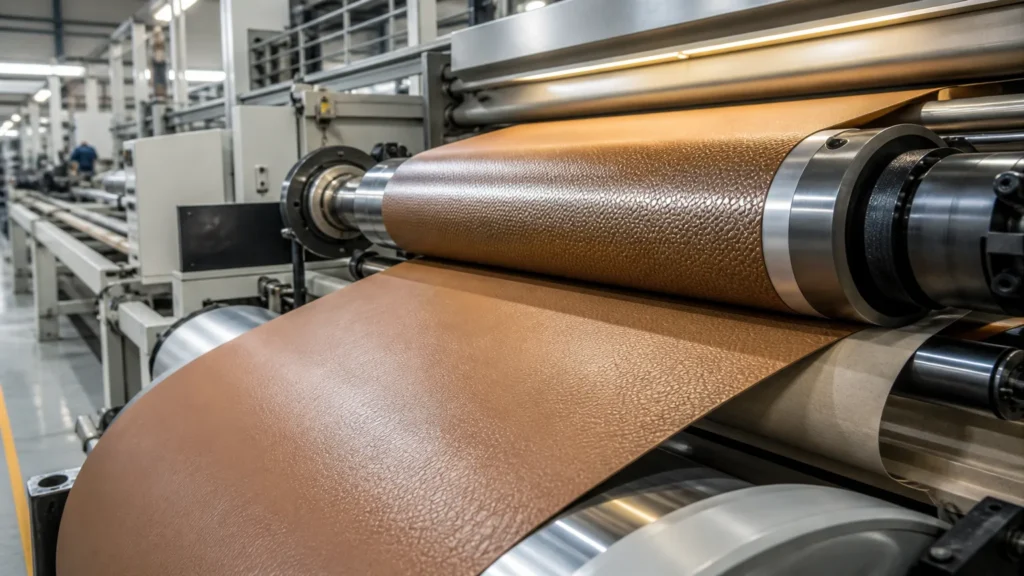
The surface is embossed with a grain pattern using heated rollers, then finished with topcoats that adjust gloss, hand feel, abrasion resistance, and cleanability. Finishing is where much of the perceived quality and brand-specific look is created.
Quality control & testing
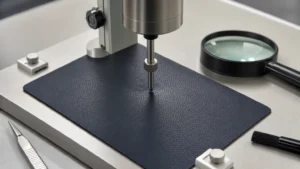
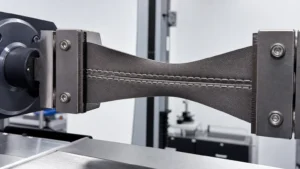
Finished material is checked against performance targets. Because manufacturing defects surface as measurable failures, producers verify properties such as tensile and tear strength and coating adhesion before shipment. Testing closes the loop between how the material is made and how it will perform.
Solvent-based vs Water-based Manufacturing
A major distinction in how synthetic leather is made today is the choice between solvent-based and water-based or solvent-free systems. Traditional wet-process production uses solvents such as DMF, which raise environmental and compliance concerns. Water-based and solvent-free polyurethane systems reduce harmful emissions and help meet regulations such as REACH. This shift is central to sustainable PU leather and is increasingly demanded by global buyers. Moisture behavior during and after production also links to hydrolysis resistance.
How Manufacturing Affects Quality & Performance
Every production choice — backing selection, coating chemistry, process route, curing, and finishing — feeds directly into the final performance. A thicker, well-cured coating resists abrasion; proper lamination prevents delamination; the right process route delivers the intended softness and breathability. This is also what separates material types: the difference between microfiber leather and PU leather begins on the production line. Understanding how synthetic leather is made lets buyers connect a spec sheet to real-world behavior.
Why Process Expertise Matters
Consistent quality depends on process control. Small variations in coating thickness, curing temperature, or lamination pressure create batch-to-batch differences that show up as defects in the field. As a technical manufacturer, Taite controls each stage of how synthetic leather is made to deliver stable, repeatable performance across production runs — which is what B2B buyers rely on for large, recurring orders.
Sıkça Sorulan Sorular
What is synthetic leather made of?
Synthetic leather is made of a textile backing fabric, one or more polymer coating layers (usually polyurethane or PVC), and a surface finish. The layers together provide strength, appearance, and durability.
What is the difference between wet and dry process synthetic leather?
The dry process transfers a PU coating from release paper to the backing, giving a consistent surface at lower cost. The wet process coagulates PU into a microporous, breathable structure that feels closer to genuine leather but costs more.
Is synthetic leather manufacturing eco-friendly?
It is becoming more so. Water-based and solvent-free processes reduce harmful solvent emissions compared with traditional DMF-based production, helping manufacturers meet regulations such as REACH.
How does manufacturing affect synthetic leather quality?
Manufacturing determines nearly every performance property. Backing choice, coating thickness, process route, curing, and finishing control strength, adhesion, feel, and durability — so how synthetic leather is made directly sets its quality.