

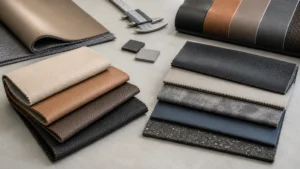
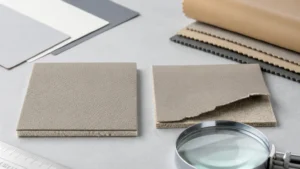

A synthetic leather cold crack test checks whether a coated surface can remain flexible after exposure to low temperatures. When synthetic leather becomes stiff in cold conditions, bending can cause fine cracks, whitening, coating breaks, or surface damage. For buyers working with automotive interiors, footwear, sports grips, bags, or furniture shipped through cold regions, this test helps turn a vague “cold resistant” claim into a measurable material requirement.
What Is a Synthetic Leather Cold Crack Test?
A synthetic leather cold crack test is a low-temperature performance check. The sample is conditioned at a specified cold temperature and then bent, folded, or flexed according to a defined method. After bending, the surface is inspected for cracking, whitening, coating separation, or other visible damage.
The test focuses on how the coated surface behaves when the material is no longer at room temperature. A material may feel flexible in a showroom but become rigid during winter transport, outdoor storage, or use in a cold climate. That is why cold crack resistance must be verified under the intended low-temperature condition, not assumed from touch alone.
This test is different from a standard synthetic leather flex test. Flex testing usually focuses on repeated bending durability, while cold crack testing focuses on whether the surface coating can survive bending after low-temperature exposure. Both tests are useful, but they answer different questions.
Why Synthetic Leather Cracks in Cold Conditions
A synthetic leather cold crack test is needed because cold conditions can reduce flexibility in coated synthetic leather. As temperature drops, the coating may become harder and less able to stretch with the base fabric. If the surface layer cannot follow the bending movement, small cracks can appear at the fold line.
Several factors influence this risk. The resin system, plasticizer balance, coating thickness, base fabric, embossing pattern, and finishing layer can all affect low-temperature flexibility. A very thick coating may look durable, but it can become less flexible if the formulation is not suitable for cold conditions.
Cracking often appears in areas that bend first: shoe vamps, bag corners, grip wraps, car seat bolsters, upholstery seams, or folded rolls during transport. These failures may look like a surface defect, but the root cause can be poor cold flexibility. This is why low-temperature testing should be connected with broader PU leather quality problems and solutions.
Moisture, storage time, and sudden temperature changes can also make the problem more visible. For example, a roll stored in a cold warehouse may not crack while lying flat, but cracking can appear when the material is unrolled, folded, or cut before it has recovered to a workable temperature.
Common Standards for a Synthetic Leather Cold Crack Test
The most important rule in a synthetic leather cold crack test is to specify a test method instead of using general language. “Cold resistant” is not precise enough for engineering, QC, or supplier communication. A buyer should define the standard, temperature, sample direction, bending method, and pass/fail criteria.
One relevant international reference is ISO 17233:2017, which covers the determination of cold crack temperature for surface coatings applied to leather. It is useful when evaluating coated surfaces that can be flexed and inspected for cracking at low temperature.
Another commonly discussed method is ASTM D2136, a low-temperature bend test for coated fabrics. It is often referenced when buyers need to evaluate whether a coated material remains bendable without cracking under a specified cold condition.
Different buyers and laboratories may use different fixtures, sample sizes, temperatures, conditioning times, and judgment rules. Taite should not treat one single temperature as universal. The correct requirement depends on the application, climate, shipment route, and customer specification.

How a Synthetic Leather Cold Crack Test Is Usually Performed
A typical synthetic leather cold crack test begins with sample preparation. The material is cut into test specimens according to the selected method. The direction of the specimen can matter because base fabric structure and coating orientation may influence the way the material bends.
The sample is then conditioned at a specified low temperature. The conditioning time should be long enough for the material to reach the target test condition. After conditioning, the sample is bent or folded using the required fixture or procedure.
After bending, the inspector checks the surface visually and sometimes with magnification. The main signs to record are surface cracks, whitening, coating rupture, delamination, peeling, or other visible damage. The report should state the temperature, test method, conditioning details, specimen direction, and observed result.
A clear synthetic leather cold crack test report matters because the same material may pass one condition and fail another. Without the method and temperature, a simple “pass” result does not tell the buyer enough.
Synthetic Leather Cold Crack Test vs Flex Test vs Abrasion Test
A synthetic leather cold crack test, a flex test, and an abrasion test are related, but they do not measure the same failure mode. A buyer should not replace one with another. The best quality review uses the right combination based on the final product.
| Test | Main Stress | What It Shows | Typical Failure |
|---|---|---|---|
| Synthetic leather cold crack test | Low temperature + bending | Surface resistance after cold exposure | Cracks or whitening after winter use or shipping |
| Flex test | Repeated bending | Long-term fold durability | Cracks at bend lines |
| Abrasion test | Surface rubbing | Wear resistance | Coating wear or surface loss |
For example, a material may perform well in the Martindale abrasion test but still crack when folded in a cold environment. Another material may pass cold crack testing but need stronger abrasion resistance for high-contact surfaces. The final specification should reflect the actual stress conditions.
Which Applications Need a Synthetic Leather Cold Crack Test?
A synthetic leather cold crack test is most important when the finished product may be stored, shipped, installed, or used in cold environments. The requirement may be driven by the target market, logistics route, seasonal use, or the way the product bends during service.
Automotive materials can face cold cabins, outdoor parking, and winter transport. When synthetic leather is used for seats, door panels, or trim, buyers should evaluate cold flexibility together with abrasion and cleaning performance. This is especially relevant for car upholstery leather used in regions with wide temperature changes.
Footwear materials bend repeatedly during walking, and low temperature can make the upper less flexible. A material that looks acceptable at room temperature may crack at the vamp when used in winter conditions. Buyers developing shoe products should review cold crack resistance when selecting PU leather for shoes.
Sports grips may be handled outdoors or stored in cold environments. If the surface becomes hard or brittle, comfort and durability both suffer. For grip wraps and handle materials, connect cold flexibility with the application needs of 그립 패브릭.
Bags and luggage can experience cold storage, winter transport, and bending at corners or handles. Buyers sourcing bag fabric should consider whether the material will be shipped or used in cold areas.
Furniture materials may be transported through cold warehouses or installed in regions with strong temperature swings. For furniture leather fabric, cold crack testing can be relevant when large panels are folded, stretched, or handled during delivery and upholstery.
How Material Construction Affects Synthetic Leather Cold Crack Test Results
Material construction is one of the biggest reasons synthetic leather cold crack test results differ. Synthetic leather is not one single material. The coating system, backing fabric, surface finish, thickness, and production process all shape low-temperature behavior.
PU 가죽 can be formulated for different levels of softness, strength, surface touch, and flexibility. A flexible PU formulation may perform better in cold bending than a rigid surface system, but the result still depends on the complete construction.
12. 수성 PU 가죽 and solvent-free PU leather may be selected for environmental or process reasons, but buyers should still ask for application-specific performance data. Environmental positioning does not automatically prove cold crack resistance.
Silicone leather may offer a different surface feel and cleanability profile, but it should still be evaluated with the same discipline: confirm the application, define the test condition, and inspect results after low-temperature bending.
Thickness can also influence performance. A thicker material may feel stronger, but it may resist bending more if the coating is not flexible enough. This is why thickness should be reviewed together with the guide to synthetic leather thickness, not treated as a simple “thicker is better” rule.
How Buyers Should Specify Synthetic Leather Cold Crack Test Requirements
Buyers should begin a synthetic leather cold crack test specification with the target environment. Is the material used indoors, outdoors, in winter shipping, in a vehicle cabin, on footwear, or in sports equipment? The answer determines whether cold crack resistance is essential or only a secondary concern.
A useful specification should include the test standard, target temperature, conditioning time, sample direction, bending method, and pass/fail rule. Instead of writing “cold resistant,” write a requirement that the supplier and laboratory can actually test.
Buyers should also connect cold crack testing with other relevant checks. If coating damage appears after low-temperature bending, coating bond strength may need review through a synthetic leather coating adhesion test. If the material will also bend repeatedly during use, cold crack testing should be combined with flex testing.
For important projects, ask the supplier to test sample material before bulk production and keep the report with the approved sample. During mass production, the agreed test condition can be used as part of quality control or customer approval.
자주 묻는 질문
What is a synthetic leather cold crack test?
A synthetic leather cold crack test checks whether the coated surface cracks, whitens, or breaks after the material is conditioned at a low temperature and then bent or folded. It helps buyers verify low-temperature flexibility before production or use.
Is cold crack resistance the same as flex resistance?
No. Flex resistance usually measures repeated bending durability, often at room temperature or a specified condition. Cold crack resistance focuses on bending after low-temperature exposure. A complete durability review may require both tests.
Which standard is used for cold crack testing?
ISO 17233:2017 is a relevant standard for determining cold crack temperature of surface coatings applied to leather. ASTM D2136 is also commonly discussed for low-temperature bend testing of coated fabrics. The final method should follow the buyer’s specification or the chosen laboratory procedure.
How can buyers reduce cold cracking risk?
Buyers can reduce risk by defining the application environment, choosing a suitable material construction, requesting synthetic leather cold crack test data, checking samples before bulk production, and avoiding vague requirements such as “cold resistant” without a test condition.