

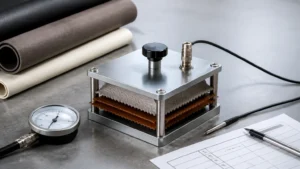
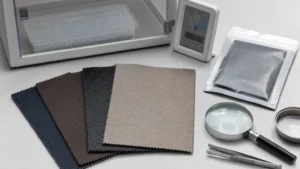
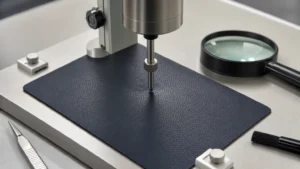
A synthetic leather blocking resistance test checks whether two material surfaces stick together, transfer coating, leave pressure marks, or become tacky after contact under controlled heat, pressure, humidity, or storage time. It is important for PU leather, microfiber leather, automotive upholstery, furniture leather fabric, medical upholstery, bags, shoes, and laminated materials because blocking can appear during roll storage, shipping, stacking, hot pressing, or finished-product assembly.
For buyers, blocking is a hidden quality risk. A roll may look normal at the supplier’s warehouse, but after hot container shipping or stacked storage, the surface can become sticky, glossy, imprinted, or difficult to separate. In severe cases, coating transfer or delamination appears when the layers are pulled apart. This is why blocking resistance should be considered during material development, not only after a complaint.
What Is a Synthetic Leather Blocking Resistance Test?
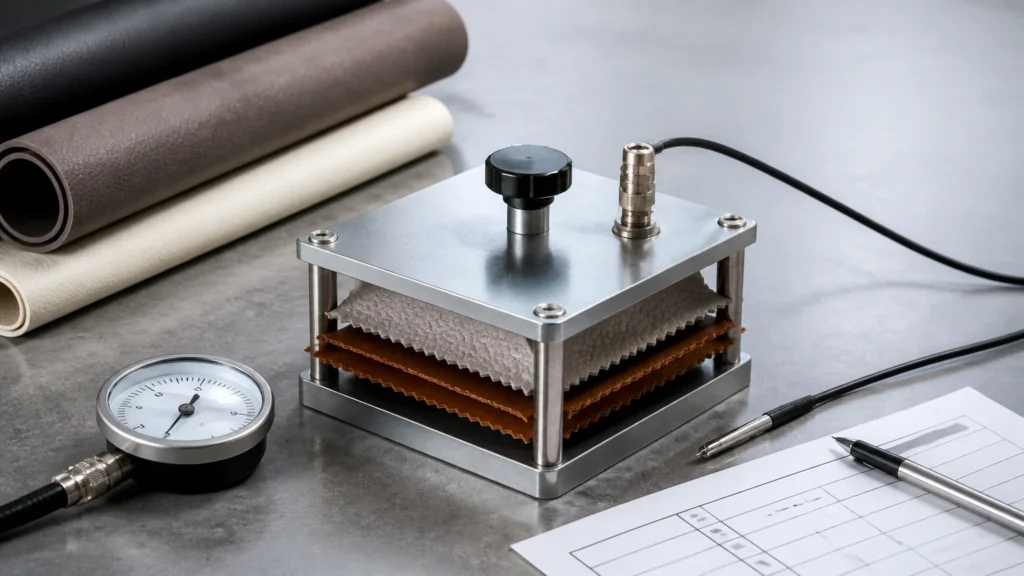
A synthetic leather blocking resistance test evaluates whether the material surface remains stable when it touches another surface under defined conditions. The contact may be face-to-face, face-to-backing, face-to-packaging film, face-to-foam, or face-to-another component in the finished product.
Blocking is not simply a stain, scratch, or peel. It is a surface-to-surface contact problem. The material may pass abrasion, water resistance, and ordinary cleaning checks, yet still fail when rolled tightly, stacked under pressure, stored in heat, or pressed against packaging for a long time.
In B2B purchasing, the test helps answer a practical question: will this synthetic leather stay usable after the real storage, transportation, assembly, and application conditions of the project? If the buyer only checks appearance on a fresh flat sample, blocking risk may be missed.
Why Blocking Happens in Synthetic Leather
Blocking can have several causes. Some are related to the surface coating, while others come from additives, storage conditions, packaging materials, or the finished product design. A good failure analysis should avoid blaming only one factor before checking the full system.
Surface topcoat softening
The topcoat is the first layer that contacts another surface. Under heat or pressure, an insufficiently cured, overly soft, or incompatible topcoat may become tacky. The result may be a sticky feel, surface imprint, gloss change, or coating transfer. This risk is especially important for high-gloss, soft-touch, embossed, or coated synthetic leather surfaces.
Plasticizer or additive migration
Some formulations include plasticizers, processing aids, softeners, pigments, or finishing additives. If these ingredients migrate to the surface, they may change surface energy and create tackiness. This does not mean every PU leather or PVC leather will block, but it does mean the formulation and storage condition should be checked when the final product faces heat and pressure.
Heat, humidity, and storage pressure
Blocking is often accelerated by heat, humidity, and pressure. Long-distance shipping, summer container storage, high warehouse temperature, tight roll winding, stacked sheets, or compressed packaging can create a harsher condition than a normal room-temperature sample review. A synthetic leather blocking resistance test should therefore reflect the real storage and shipping risk of the order.
Contact with packaging, foam, film, or adhesives
Sometimes the synthetic leather itself is not the only cause. Packaging film, release paper, foam, adhesive, printed components, backing cloth, or adjacent materials may react with the surface. In finished products, blocking can occur between the leather surface and a foam pad, protective film, carton liner, printed panel, or stacked component. Buyers should test the contact pair that actually exists in production.
What Does a Blocking Test Evaluate?
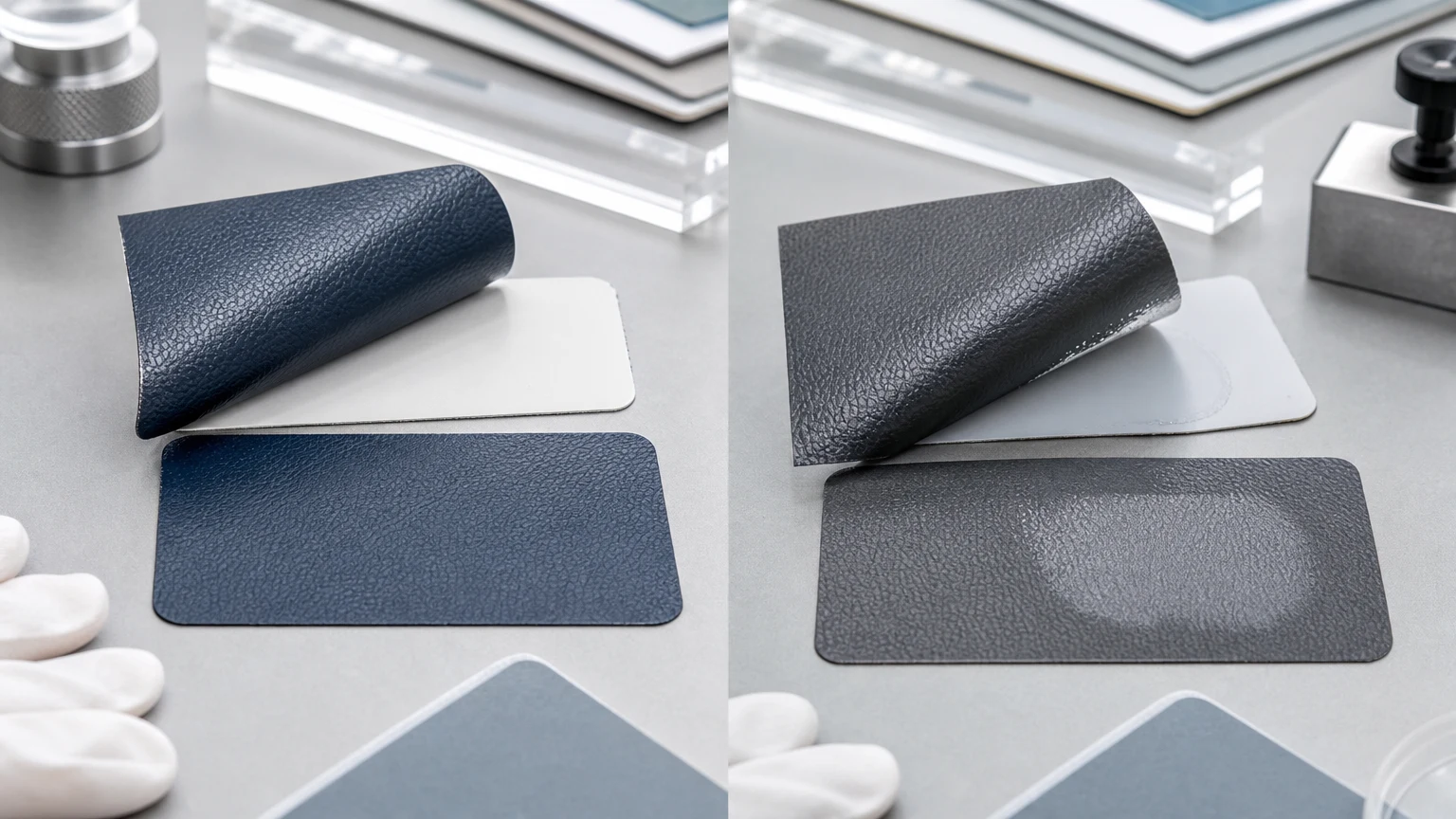
A blocking test should evaluate more than whether the sample can be pulled apart. A surface may separate easily but still show unacceptable gloss change, pressure marks, residue, tackiness, or coating transfer. The acceptance criteria should be written before testing.
| Evaluation Item | What It Means | Buyer Concern |
|---|---|---|
| Surface sticking | Two surfaces are difficult to separate | Roll storage, stacking, shipping |
| Coating transfer | Color or finish moves to another surface | Upholstery, bags, shoes, packaging |
| Gloss change | Surface becomes shiny or dull after contact | Premium appearance consistency |
| Pressure marks | Imprints remain after stacking or heat | Automotive and furniture panels |
| Tackiness | Surface feels sticky after heat or aging | Indoor comfort and quality complaints |
| Delamination risk | Surface damage exposes coating weakness | Long-term durability |
The test result is meaningful only when the conditions are clear. Temperature, pressure, humidity, contact surface, exposure time, sample direction, and post-test evaluation method should be defined according to the real project. A universal pass/fail number without application context can mislead both buyer and supplier.
How a Synthetic Leather Blocking Resistance Test Is Usually Designed
A practical synthetic leather blocking resistance test starts with the product risk. A rolled material for bag production, a laminated automotive panel, a medical pad, and a furniture upholstery sheet may all need different contact conditions. The method should be repeatable and documented, but it should not be copied blindly from another product category.
Sample preparation
Samples should represent the material that will be approved for bulk production. The surface finish, backing, thickness, embossing, color, lamination, and any post-treatment should match the production version. If the finished product includes cleaning, aging, printing, bonding, or heat pressing, buyers may need to test both the flat material and the processed construction.
Contact condition
The most important design choice is what touches what. Common combinations include face-to-face material contact, face-to-backing contact, face-to-packaging film, face-to-foam, or face-to-another synthetic leather surface. For rolls, face-to-backing or face-to-face pressure may matter. For finished parts, the real contact surface in storage or assembly should be tested.
Heat, pressure, humidity, and time
Heat and pressure can soften surface finishes and reveal tackiness. Humidity can accelerate some coating or backing interactions. Time matters because a short contact may pass while long storage may fail. The chosen condition should reflect the expected shipping route, warehouse environment, product packaging, or production process.
Post-test evaluation
After exposure, the evaluator should separate the materials carefully and record the result. Useful observations include separation force, coating transfer, residue, odor, surface tack, gloss change, color change, pressure imprint, whitening, cracking, delamination, and whether the material returns to normal after rest. Photos before and after testing help avoid subjective arguments.
Blocking vs Adhesion, Hydrolysis, Stain Resistance, and Fogging
Blocking resistance overlaps with other durability topics, but it should not be treated as the same test. Separating the concepts helps buyers write clearer specifications and prevents content overlap with other Taite technical guides.
| Test or Issue | Main Question | Different From Blocking Because… |
|---|---|---|
| Blocking resistance | Will surfaces stick under heat, pressure, or storage? | It focuses on surface-to-surface contact stability |
| Coating adhesion | Does the coating stay bonded to the backing? | It focuses on layer bonding strength |
| Resistencia a la hidrólisis | Does moisture and heat degrade the PU structure? | It focuses on chemical aging of the material system |
| Stain resistance | Can contaminants be removed without surface damage? | It focuses on contamination and cleaning outcome |
| Fogging test | Will volatiles condense on glass or film? | It focuses on emissions under heat |
For related technical checks, buyers can compare this topic with Taite’s guides on synthetic leather coating adhesion testing, hydrolysis resistance of PU leather, synthetic leather stain resistance testing, y synthetic leather fogging testing.
Which Applications Need Blocking Resistance?
Any product that is rolled, stacked, pressed, packed, stored in heat, or assembled with foam, film, adhesive, or another layer may need blocking resistance evaluation. The risk becomes higher when the product uses a soft-touch finish, high-gloss finish, light color, thick coating, tight packaging, or long shipping route.
Automotive upholstery and interior panels
Automotive materials may face high cabin temperatures, compact storage, stacked components, and contact with foam or other trim parts. Blocking may appear as pressure marks, gloss change, tacky feel, or coating transfer. For car interiors, blocking should be reviewed together with fogging, odor, heat aging, abrasion, and cleaning resistance. Taite’s car upholstery leather page is the relevant application reference.
Furniture leather fabric
Furniture leather fabric is commonly stored in rolls and later assembled with foam, wood, adhesive, or packaging materials. If the surface is too soft or the packaging system is incompatible, the upholstery may show pressure marks or tackiness after storage. For public seating and premium furniture, surface feel and appearance consistency are especially important. Buyers can connect this topic with Taite’s furniture leather fabric materials.
Medical product leather fabrics
Medical upholstery may experience repeated cleaning, disinfection, body contact, foam contact, and compressed packaging. Blocking resistance should be considered together with chemical resistance and cleanability. A surface that becomes tacky after cleaning or storage can create hygiene, comfort, and maintenance problems. Taite’s medical product leather fabrics page is relevant for these projects.
Bags, shoes, and laminated products
Bags and shoes often involve heat pressing, bonding, lamination, lining materials, protective films, and stacked parts. Blocking can show up as imprint marks, coating transfer, or surface damage when parts are packed together too soon after processing. For bag projects, buyers may also need to evaluate scratch resistance, color transfer, and surface stability. Taite’s bag fabric page can support this selection process.
Sports grips and equipment
Sports grips, gloves, balls, and equipment surfaces require a controlled hand feel. Some tackiness may be intentionally designed for grip, while uncontrolled stickiness after heat or storage is a quality failure. Buyers should define the difference clearly. Grip materials may need blocking checks together with abrasion, sweat, water, and flex resistance. Taite’s tejido antideslizante page is a useful application reference.
How Buyers Should Specify Blocking Resistance
The best way to avoid disputes is to specify blocking resistance before sampling. A vague requirement such as “no sticky surface” is not enough. The buyer should describe what surfaces touch, under what condition, for how long, and how the material will be judged after testing.
- Define the final application and expected storage route.
- Identify what surfaces will touch during roll storage, stacking, packing, or assembly.
- Specify the contact type: face-to-face, face-to-backing, face-to-film, face-to-foam, or face-to-adhesive layer.
- Define temperature, pressure, humidity, and duration based on realistic shipping or storage conditions.
- Define pass/fail criteria: no sticking, no coating transfer, no unacceptable gloss change, no pressure mark, and no tackiness.
- Test after aging, cleaning, or heat pressing if the finished product requires it.
- Approve bulk production based on tested samples, not only supplier claims.
Material selection also matters. Taite offers different synthetic leather families, including Cuero PU, cuero microfibra, silicone leather, water based PU leather, y solvent free PU leather. Each material should be matched to the project’s surface feel, storage risk, processing method, and cost target.
Common Failure Causes and Corrective Actions
When blocking appears, the corrective action depends on the actual cause. The solution may involve changing the topcoat, adjusting curing, modifying packaging, improving storage conditions, changing the backing, or testing contact materials before mass production.
| Failure | Possible Cause | Corrective Action |
|---|---|---|
| Surface tackiness | Topcoat softening, additive migration, under-cure | Adjust topcoat, curing, resin system, or storage condition |
| Coating transfer | Incompatible contact surface or poor finish stability | Test contact materials and improve finish compatibility |
| Gloss change | Heat or pressure mark, surface softening | Adjust finish, packaging, or stacking pressure |
| Pressure imprint | Excessive stacking pressure or soft surface | Use protective interleaving or change storage method |
| Delamination after separation | Weak layer bonding revealed by blocking | Review adhesion, backing, coating process, and lamination |
Corrective action should be verified with another test. If the solution only works at room temperature but fails after heat storage, the problem has not been solved. If a protective film prevents blocking but leaves residue, it may create a different defect. A complete approval plan should evaluate both the material and its packaging system.
FAQ
What is blocking in synthetic leather?
Blocking means two surfaces stick together or influence each other after contact under pressure, heat, humidity, or storage time. It may cause surface tackiness, coating transfer, pressure marks, gloss change, or separation damage.
Why does PU leather become sticky after storage?
PU leather may become sticky after storage if the surface topcoat softens, additives migrate, curing is insufficient, humidity accelerates aging, or the material contacts incompatible packaging, foam, film, or adhesive surfaces.
Is blocking the same as coating adhesion failure?
No. Coating adhesion failure focuses on bonding between coating and backing. Blocking focuses on whether the surface sticks to another surface during storage, stacking, heat exposure, or packaging contact. Severe blocking may reveal weak adhesion, but the two issues are not identical.
How do you test blocking resistance?
A synthetic leather blocking resistance test usually places defined surfaces in contact under controlled heat, pressure, humidity, and time, then checks separation, tackiness, coating transfer, gloss change, pressure marks, and surface damage.
What causes coating transfer between synthetic leather surfaces?
Coating transfer may be caused by an unstable topcoat, insufficient curing, additive migration, heat, pressure, or contact with an incompatible surface. The contact pair should be tested, not only the leather surface alone.
Which products need blocking resistance testing?
Automotive upholstery, furniture leather fabric, medical upholstery, bags, shoes, sports grips, laminated materials, and rolled or stacked synthetic leather products may need blocking resistance testing when heat, pressure, storage, or packaging contact is expected.
Can packaging film cause synthetic leather blocking?
Yes. Packaging film, foam, paper, adhesive layers, printed materials, or protective sheets may interact with the synthetic leather surface. Buyers should test the actual packaging system when blocking risk is important.
What should buyers ask suppliers before approving bulk production?
Buyers should ask what contact condition was tested, what heat and pressure were used, whether packaging materials were included, what defects were checked, and whether the sample still meets appearance and hand-feel requirements after the test.
Final Thoughts
A synthetic leather blocking resistance test is a practical quality-control tool for preventing storage, shipping, packaging, and assembly failures. It helps buyers identify whether a synthetic leather surface will remain stable when it is rolled, stacked, pressed, heated, or stored in contact with another material.
For automotive interiors, furniture, medical products, bags, shoes, and sports equipment, blocking resistance should be evaluated together with adhesion, hydrolysis, stain resistance, fogging, water resistance, scratch resistance, and cleaning compatibility. If your project needs a synthetic leather material with specific anti-blocking, surface feel, coating stability, and storage requirements, contact Taite through the contact page to discuss samples and specifications before bulk production.