

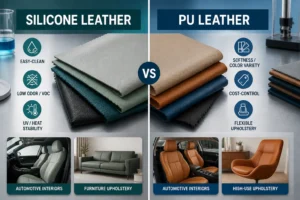
Silicone leather vs PU leather is a practical material comparison for buyers choosing synthetic leather for automotive interiors, furniture, medical surfaces, public seating, marine products, and other high-use applications. PU leather uses a polyurethane surface system and is widely chosen for softness, flexibility, color variety, and cost efficiency. Silicone leather uses a silicone-based surface layer and is often selected when easier cleaning, lower odor, low VOC direction, UV resistance, stain resistance, or long-term surface stability is more important. Neither material is automatically better for every product. Buyers should compare surface chemistry, backing, cleaning routine, heat and UV exposure, durability targets, budget, and physical samples before bulk production.
The best choice depends on the finished product. A cost-sensitive sofa line, fashion bag, or general upholstery project may work well with a properly specified PU material. A high-use car interior, healthcare surface, public seating product, or premium furniture line may need a cleaner, more stable, and easier-maintenance surface. The goal is not to replace one material with another in every case, but to match the material system to the real application.

Silicone Leather vs PU Leather: Quick Answer for Buyers
PU leather is usually the more flexible and cost-accessible choice. It offers broad texture options, soft hand feel, and strong supply availability across furniture, bags, shoes, automotive trim, and many other products. Silicone leather is usually considered when surface performance matters more than the lowest material cost. It is often evaluated for easy cleaning, low odor direction, low VOC direction, weathering resistance, and stable surface behavior in demanding environments.
That does not mean silicone leather is always the better option. A high-quality PU leather can perform very well when the coating, base fabric, thickness, hydrolysis resistance, abrasion resistance, and colorfastness match the application. A poor silicone leather construction can still fail if the backing, coating thickness, or production control is unsuitable. Buyers should compare samples and test data rather than rely only on the material name.
¿Qué es la piel de PU?
PU leather is a synthetic leather material that uses a polyurethane-based surface system on a fabric or leather-like backing. It is widely used because it can offer a soft hand feel, flexible surface, rich colors, different grains, and cost control for mass production. For many furniture, footwear, bag, and automotive projects, PU remains a practical starting point.
The main advantage of PU leather is its versatility. It can be made softer or firmer, matte or glossy, smooth or textured, thin or thick, depending on the target product. Buyers who need broad design freedom and stable sourcing often start with the PU leather material range before considering higher-performance alternatives.
However, PU leather quality varies widely. Low-grade PU may face problems such as hydrolysis, peeling, surface stickiness, odor, cracking, or poor color stability. A better PU construction can perform much better, especially when the resin system, base fabric, coating adhesion, and finishing process are controlled. This is why buyers should review test data and physical samples before approving bulk production.
What Is Silicone Leather?
Silicone leather is a synthetic leather-like material that uses a silicone-based surface layer instead of a traditional polyurethane top surface. It is often considered for applications where easy cleaning, lower odor, low VOC direction, weathering resistance, skin contact comfort, and long-term surface stability are important.
On the verified silicone leather product page, the material is positioned for applications such as sofas, cars, ships, mobile phone cases, public facilities, sports goods, medical equipment, outdoor furniture, and other demanding surfaces. The page also highlights directions such as easy cleaning, no odor, extremely low VOC, durability, disinfection, hydrolysis resistance, and light/yellowing resistance.
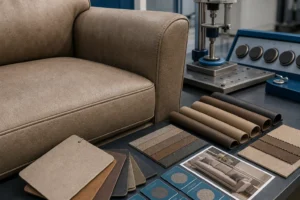
Still, buyers should not treat the word “silicone” as a guarantee. The actual performance depends on the surface layer, substrate, thickness, grain, coating structure, color system, and production consistency. Silicone leather should be evaluated through samples, cleaning tests, abrasion tests, UV exposure checks, and application-specific requirements.
Key Differences Between Silicone Leather and PU Leather
The key difference is the surface chemistry. PU leather uses a polyurethane-based system, while silicone leather uses a silicone-based surface layer. That difference can influence how the material cleans, how it feels, how it reacts to stains, how it handles heat and UV exposure, and how stable the surface remains after long use.
| Comparison point | Cuero PU | Silicone leather | Buyer note |
|---|---|---|---|
| Surface system | Polyurethane-based | Silicone-based | Chemistry affects cleaning and aging behavior |
| Coste | Usually more cost-flexible | Usually higher cost | Match budget to application value |
| Hand feel | Soft and versatile | Smooth, stable, often premium | Confirm with samples |
| Limpieza | Depends on coating grade | Often selected for easier cleaning | Test with real cleaning agents |
| Odor / VOC | Depends on formulation | Often chosen for low odor / low VOC direction | Request test data |
| Heat / UV | Grade dependent | Often selected for better weathering direction | Do not assume without tests |
| Aplicaciones | Furniture, bags, shoes, automotive, general use | Automotive, medical, public seating, outdoor-adjacent, premium furniture | Match material to use case |
Which Material Is Better for Automotive Interiors?
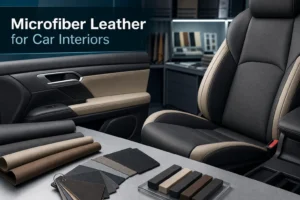
Automotive interiors are one of the most demanding areas for synthetic leather. Seat covers, door panels, armrests, dashboards, and EV interior surfaces may face heat, UV, abrasion, sweat, cleaning agents, odor requirements, fogging limits, and flame-retardancy expectations. A material that looks good on a small swatch may not be suitable for the full cabin environment.
PU leather can be a strong choice for mid-range automotive interiors when the project needs soft touch, design flexibility, and cost control. It can work well for seat covers, panels, and trim when the grade is designed for automotive use. Silicone leather may be more attractive when the project needs easier cleaning, lower odor direction, low VOC direction, better surface stability, or high-use performance. For automotive programs, compare material options against real car upholstery leather applications rather than judging only by the label.
Which Material Is Better for Furniture and Public Seating?
Furniture and public seating projects need a balance of comfort, durability, cleaning, price, color, and surface feel. PU leather remains a strong option for many sofas, hotel furniture, office chairs, dining chairs, and commercial seating products because it can offer a soft feel and many design options at a manageable cost.
Silicone leather becomes more attractive when cleaning frequency, stain resistance, odor control, skin contact comfort, and long-term surface appearance carry more weight. Public seating, healthcare waiting areas, children’s spaces, premium furniture, and outdoor-adjacent furniture may benefit from a surface designed for easier maintenance. The final decision should still be based on samples and project-level test requirements.
Cleaning, Stain Resistance, and Daily Maintenance
Cleanability is one of the most common reasons buyers compare silicone leather vs PU leather. A surface that releases common stains more easily can reduce maintenance pressure and help the finished product look newer for longer. This matters in healthcare, hospitality, transportation, public seating, children’s furniture, and busy commercial interiors.
PU leather can also be easy to clean when the coating is well designed. Some PU materials are made specifically for anti-fouling or easy-clean applications. The risk is that buyers sometimes compare a high-performance silicone leather with a low-grade PU sample, then assume the result applies to every PU material. A fair comparison should use materials designed for the same application level and cleaning routine.
Buyers should also test cleaning agents carefully. No material should be assumed to resist every alcohol, bleach, solvent, disinfectant, or aggressive chemical. Cleaning performance depends on concentration, contact time, wiping method, surface finish, and aging condition.
Durability, Heat, UV, and Hydrolysis Resistance
Durability is not a single property. For synthetic leather, it can include abrasion resistance, coating adhesion, hydrolysis resistance, heat aging, UV exposure, colorfastness, flexing, cleaning response, and backing strength. PU leather can perform well when the formula and backing are suitable, but low-grade PU may fail earlier under humidity, heat, or repeated use.
Silicone leather is often selected for projects where surface stability and environmental resistance are higher priorities. The article on what silicone leather is explains that buyers should compare surface, backing, flexibility, and compliance profile rather than rely on a generic material name. This same logic applies when comparing silicone and PU systems for high-use products.
Cost and Sourcing: When PU Leather Still Makes Sense
PU leather still makes sense in many projects. If the buyer needs cost control, color flexibility, a soft hand feel, fast sourcing, or broad design options, PU may be the more practical choice. It is especially useful for general furniture, bags, shoes, promotional products, and mid-range interiors where the application does not require extreme cleaning or weathering performance.
Silicone leather usually makes sense when the product value justifies the higher material cost. If the finished product will face frequent cleaning, public use, sunlight, skin contact, odor-sensitive interiors, or higher warranty expectations, the added cost may be easier to justify. Buyers should compare total value, not only material price per meter.
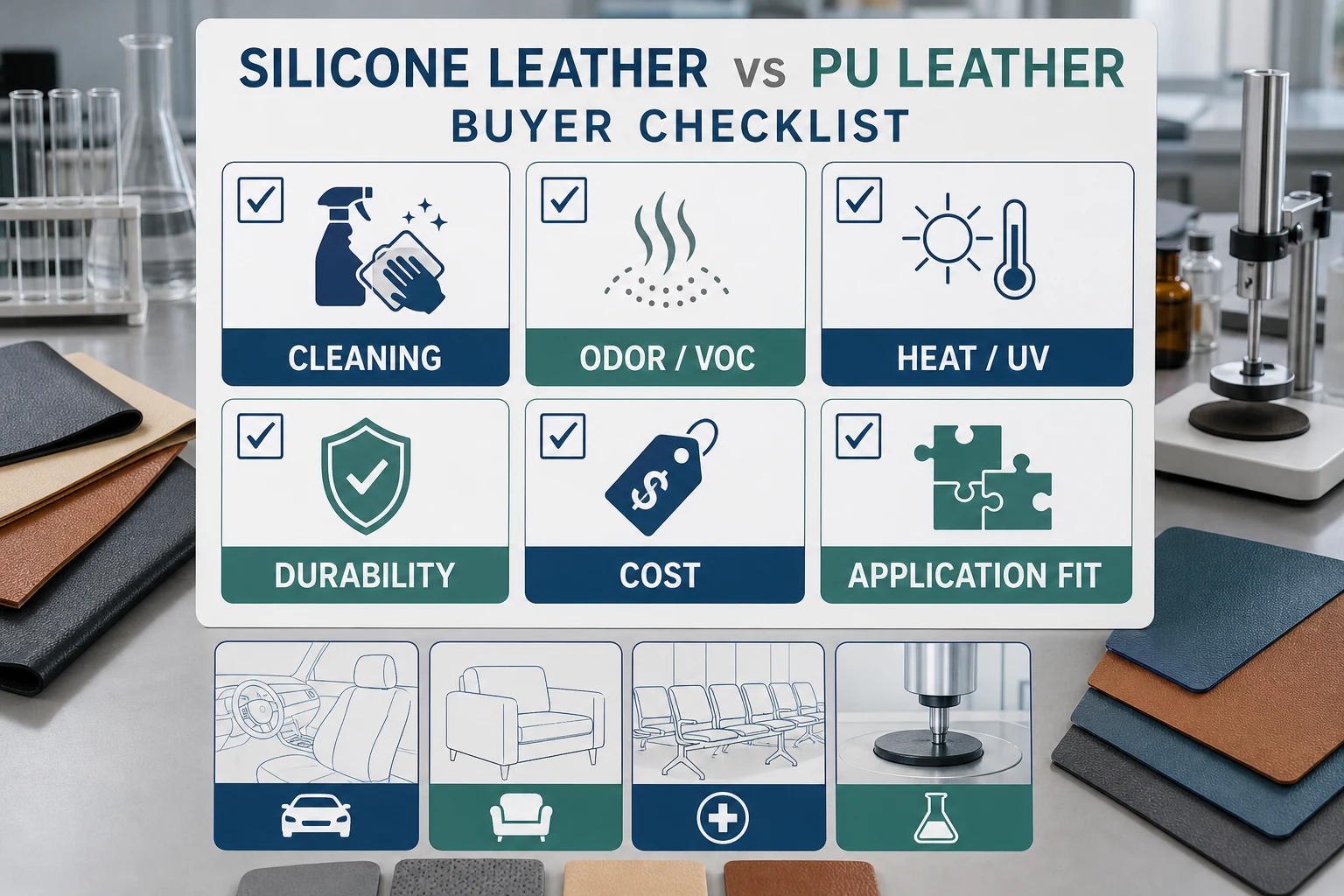
Buyer Checklist: How to Choose Between Silicone Leather and PU Leather
Before choosing either material, define the product application clearly. A car interior, sofa, medical surface, public seating product, bag, electronic accessory, marine surface, and outdoor-adjacent furniture panel all face different use conditions. The correct material depends on exposure, cleaning routine, budget, compliance needs, and expected product life.
Buyers should also understand category language. PU is one type of synthetic leather, while silicone leather is another material system. If your team is still clarifying terms, the article on PU leather vs faux leather can help separate broad category names from specific material systems before comparing higher-performance options.
| Buyer question | Why it matters | Material selection hint |
|---|---|---|
| Is cost control the top priority? | Material price may drive the project | Start with PU leather |
| Is easy cleaning a core requirement? | Public and medical surfaces need frequent wiping | Compare silicone leather and high-grade easy-clean PU |
| Is odor or VOC critical? | Closed interiors and skin-contact products need attention | Request test data for both materials |
| Will the product face heat or sunlight? | UV and heat can change surface behavior | Check heat aging and UV data |
| Is the product premium or high-use? | Maintenance and surface stability matter more | Silicone leather may justify evaluation |
| Do you need rich colors and grains? | Design flexibility affects production selection | Compare supplier libraries and custom options |
FAQ
What is the main difference between silicone leather and PU leather?
PU leather uses a polyurethane surface system, while silicone leather uses a silicone-based surface layer. This difference affects cleaning, odor, surface feel, weathering, and long-term stability.
Is silicone leather better than PU leather?
Silicone leather may be better for easy-clean, low-odor, high-use, automotive, medical, or public seating applications, but PU leather can still be better for cost-sensitive, flexible, color-rich, and general upholstery projects.
Is silicone leather more expensive than PU leather?
In many cases, silicone leather costs more than regular PU leather, so buyers should compare total value, including durability, cleaning, maintenance, and product positioning.
Which is better for car interiors, silicone leather or PU leather?
It depends on the target vehicle, budget, heat exposure, UV exposure, VOC requirements, cleaning routine, and durability target. Silicone leather may suit premium or high-use interiors, while PU leather remains widely used for cost-effective programs.
Can PU leather be high quality?
Yes. PU leather quality varies widely. A well-designed PU leather with good coating, backing, hydrolysis resistance, and colorfastness can perform well in many applications.
How should buyers choose between silicone leather and PU leather?
Buyers should define the application, cleaning requirements, exposure conditions, budget, hand feel, backing, compliance needs, and test data, then compare physical samples before bulk production.
Conclusion: Choose by Application, Not Material Name Alone
Silicone leather and PU leather are both useful synthetic leather systems, but they serve different buying priorities. PU leather remains a practical choice for cost control, softness, color flexibility, and broad applications. Silicone leather is more suitable when buyers need stronger easy-clean performance, low odor direction, low VOC direction, surface stability, weathering resistance, and higher-use environments.
If you are comparing silicone leather vs PU leather for automotive interiors, furniture, medical surfaces, public seating, marine products, or high-use upholstery, Taite can help you evaluate surface chemistry, backing structure, cleaning response, VOC requirements, durability targets, color, texture, and sample performance before bulk production. Contact us to request samples or discuss a custom synthetic leather solution for your application.