

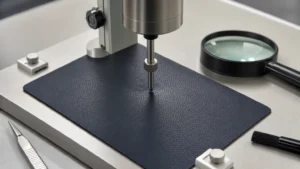
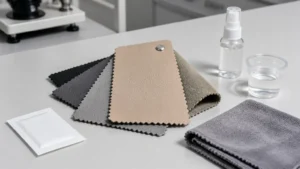
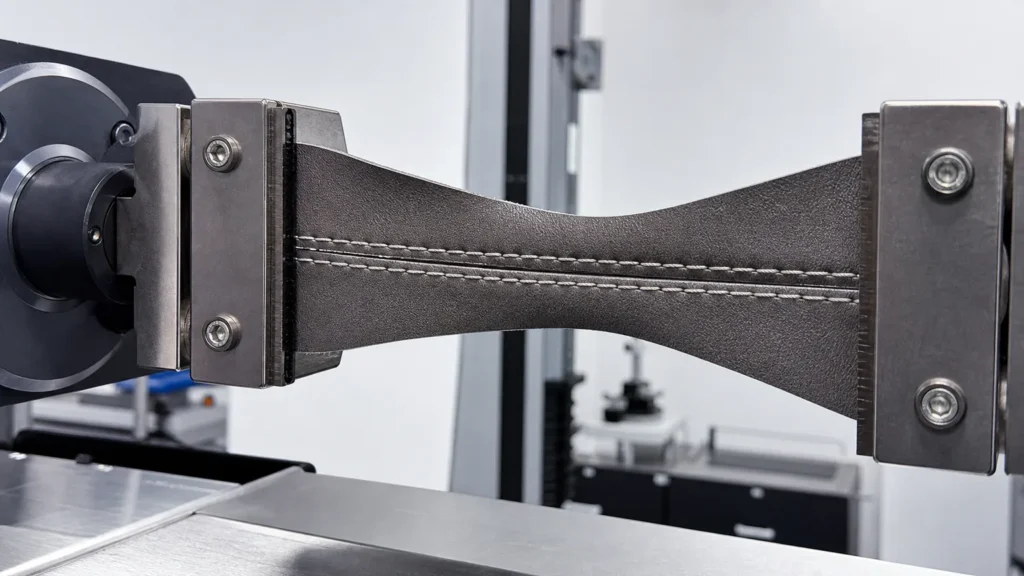
A synthetic leather seam strength test checks whether stitched or joined areas can resist pulling, tearing, and seam opening in a finished product. Many failures do not begin in the middle of a flat material sheet. They start around stitch holes, seams, folded edges, handles, trims, or bonded joints. This guide explains how seam strength testing works, why seams fail, and how buyers can write better specifications for shoes, bags, furniture, grips, and automotive upholstery.
What Is a Synthetic Leather Seam Strength Test?
A synthetic leather seam strength test measures how a sewn or joined area performs when force is applied across the seam. Instead of testing the material as a plain strip, the test focuses on the real connection zone: the stitch line, needle holes, thread, coating, backing, and the way the seam is constructed.
This matters because a material can look strong in flat-sheet testing but still fail in a finished product. A stitched panel adds holes, concentrated stress, thread pressure, and bending points. If the base fabric is weak, the coating is brittle, or the stitch pattern cuts too much of the material, the seam may open before the main sheet breaks.
A seam test is different from a general tensile or tear test. The existing Taite guide to synthetic leather tensile strength explains whole-material pulling performance and tear resistance. Seam strength testing goes one step closer to the finished product because it includes the effect of stitching and joining.
Why a Synthetic Leather Seam Strength Test Matters in Finished Products
A synthetic leather seam strength test matters because finished products often fail at their weakest construction point. In synthetic leather goods, that point is frequently a seam, needle hole, folded edge, punched hole, or handle attachment. A smooth surface may pass visual inspection, but the stitched area may still be vulnerable when the product is pulled or flexed.
Footwear is a clear example. Shoe uppers bend repeatedly, and stitch holes can concentrate stress around the vamp, quarter, lace area, and edge seams. Buyers sourcing PU leather for shoes should review seam behavior together with flexibility and tear resistance.
Bags and luggage also depend heavily on seam strength. Handles, shoulder straps, zipper panels, corners, and rivet areas carry repeated loads. A material used for bag fabric should be checked not only as a flat sheet, but also in stitched or reinforced structures similar to the final product.
Furniture upholstery has different stress points. Seat panels, backrests, welt seams, buttoned areas, and corner transitions are pulled during upholstery and repeated sitting. For furniture leather fabric, seam strength helps buyers understand whether the material can hold shape around stitched panels and tensioned corners.
Sports grips and wraps can also fail at edges or joining areas. When ткань для захвата is pulled around a handle or racket, seam-like joining areas and wrapped edges must resist peeling, tearing, and repeated hand pressure. Automotive upholstery has similar concerns around seat stitching, bolsters, and trim transitions, especially for car upholstery leather.
Common Standards for a Synthetic Leather Seam Strength Test
There is no single universal synthetic leather seam strength test for every product. The correct method depends on the material structure, product design, customer specification, and laboratory procedure. However, several standards can guide how buyers discuss seam strength.
ISO 13935-2:2014 covers seam tensile properties of fabrics and made-up textile articles using the grab method. It determines the maximum force to seam rupture when the force is applied perpendicular to the seam. For textile-backed synthetic leather, it can be a useful reference when the buyer needs a structured seam-strength discussion.
ASTM D751 is another important reference framework for coated fabrics. It includes test methods for coated fabric performance, and industry testing resources often discuss seam strength as one of the practical evaluations for coated fabric systems. For synthetic leather, the chosen method should always match the coating, backing, construction, and final application.
The key is not to quote a standard name without context. A useful specification should state the sample construction, stitch type, thread, needle size, seam allowance, test direction, pulling speed if required, and acceptance rule. Without these details, two laboratories may test “seam strength” differently and produce results that are not comparable.
How a Synthetic Leather Seam Strength Test Is Usually Performed
A synthetic leather seam strength test begins with a representative sewn sample. The material should be prepared in a way that reflects the final product as closely as possible. This means the same or similar thread, needle, stitch length, seam type, seam allowance, and reinforcement design should be recorded.
The specimen is placed in a tensile testing machine so the force pulls across the seam or in the direction specified by the method. As the machine applies load, the operator records the maximum force and observes how the seam fails.
Failure mode is as important as the number. The thread may break, the stitch line may slip, the material may tear at needle holes, the coating may crack, the backing may rupture, or the layers may separate. Each result points to a different technical cause.
A complete report should include material thickness, backing type, coating type, stitch density, thread type, needle size, specimen direction, maximum force, elongation or seam opening if measured, and the observed failure mode. This level of detail makes the result useful for both material selection and product engineering.
Synthetic Leather Seam Strength Test vs Tensile and Tear Tests
Buyers often confuse a synthetic leather seam strength test with tensile strength and tear strength. They are related, but each test describes a different risk. A strong base sheet is helpful, but it does not guarantee that a stitched product will survive real use.
| Test | What It Measures | Typical Failure | Why It Matters |
|---|---|---|---|
| Synthetic leather seam strength test | Strength of stitched or joined areas | Stitch line opens, needle holes tear, seam slips | Finished product reliability |
| Tensile strength test | Whole material under pulling load | Sheet breaks or coating/backing fails | Base material strength |
| Tear strength test | Resistance to a growing cut or notch | Cut edge propagates | Edge and notch resistance |
For example, a material may have good tensile strength but poor seam strength if the needle holes weaken the backing too much. Another material may resist tearing as a flat specimen but fail when a dense stitch line creates a perforation effect. This is why seam testing should be added when the final product relies on stitching or joining.
What Causes Failure in a Synthetic Leather Seam Strength Test?
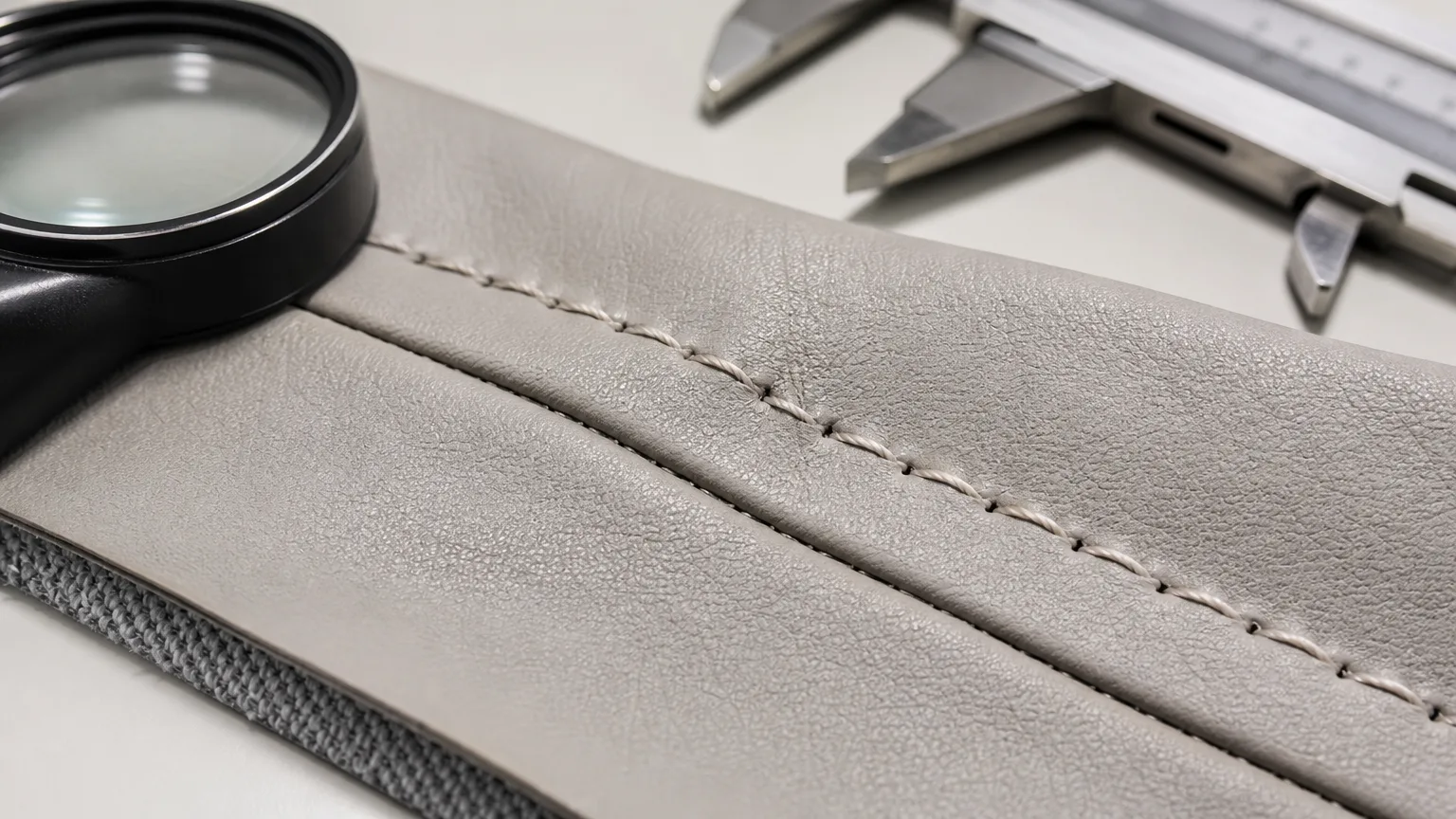
Failure in a synthetic leather seam strength test can come from the material, the sewing process, or the product design. A synthetic leather seam strength test is most useful when the failure mode is recorded, because the repair strategy depends on where the failure begins.
Needle holes are one common cause. Each needle puncture removes or separates part of the structure. If stitch density is too high, the holes can create a line of weakness, almost like a perforated tear path. This is especially risky when the backing fabric has low tear resistance or when the seam is placed in a high-load area.
Coating and backing adhesion can also affect seam behavior. If the coating separates from the backing near the stitch line, the seam may look like a sewing problem even though the root cause is interface weakness. In that case, the synthetic leather coating adhesion test becomes relevant.
Thickness and stiffness matter as well. A thicker material may be harder to sew cleanly, and excessive stiffness can concentrate stress at the seam. The guide to synthetic leather thickness explains why thickness should be evaluated together with flexibility, backing, and end-use requirements.
Thread, needle, stitch length, seam allowance, reinforcement tape, and cutting direction all influence the final result. A material supplier can provide the base material, but the finished product manufacturer must also validate the sewing construction.
Which Materials Need a Synthetic Leather Seam Strength Test?
Any synthetic leather used in stitched products may need a synthetic leather seam strength test. The need is strongest when the product carries load, bends repeatedly, or has visible seam lines that customers will use and stress.
Кожа PU is widely used in shoes, bags, furniture, grips, and upholstery, so seam behavior can vary widely by backing and coating structure. The same material name does not guarantee the same seam result.
Кожа из микрофибры is often selected for stronger structural applications, but buyers should still test the actual seam structure. A stronger base material may still fail if stitch density, needle selection, or seam design is wrong.
Полиуретановая кожа на водной основе and solvent-free PU leather may be chosen for process or environmental positioning, but the seam still needs performance verification. Environmental process type does not automatically prove seam strength.
Silicone leather has a different surface system and touch profile, but buyers should still define how the material will be joined, sewn, wrapped, or assembled. The final seam result depends on the complete structure, not only the surface chemistry.
How Buyers Should Specify Synthetic Leather Seam Strength Test Requirements
Good synthetic leather seam strength test specifications should be written around the product, not only around the material. “Strong stitching” or “good sewing performance” is too vague. A supplier, factory, and laboratory need a testable requirement.
Start by identifying the seam location and function. Is the seam decorative, structural, load-bearing, curved, folded, punched, or repeatedly flexed? A seat seam, shoe upper seam, handle attachment, and grip wrap edge may all require different review methods.
Then define the construction details: stitch type, stitch length, thread type, needle size, seam allowance, reinforcement, cutting direction, and specimen preparation. If the buyer already has an approved product structure, the test specimen should reproduce it as closely as possible.
Finally, define the test method and acceptance rule. This can include the standard, target force, acceptable seam opening, failure mode, or comparison to an approved reference. For bulk production, the same method should be used consistently so results can be compared across batches.
Seam strength is not only a supplier responsibility. It sits at the intersection of material engineering, sewing process, and product design. Buyers get better results when they test the actual construction instead of only asking for a stronger material sheet.
Часто задаваемые вопросы
What is a synthetic leather seam strength test?
A synthetic leather seam strength test measures how much force a stitched or joined area can withstand before the seam opens, the thread breaks, the material tears at needle holes, or the layers fail. It is used to evaluate finished-product reliability, not only flat material strength.
Is seam strength the same as tensile strength?
No. Tensile strength measures the base material under pulling load, while seam strength measures a stitched or joined construction. Needle holes, thread, stitch density, seam allowance, and product design all affect seam strength.
Why does synthetic leather tear at stitch holes?
Stitch holes concentrate stress and can reduce the effective strength of the material along the seam line. If the backing is weak, the stitch density is too high, the needle is too large, or the material is too stiff, tearing can begin at the holes.
How can buyers improve seam strength in finished products?
Buyers can improve seam performance by selecting a suitable material construction, testing the actual stitched structure, optimizing stitch length and needle size, using appropriate thread, adding reinforcement where needed, and defining a clear seam-strength test method before bulk production.