

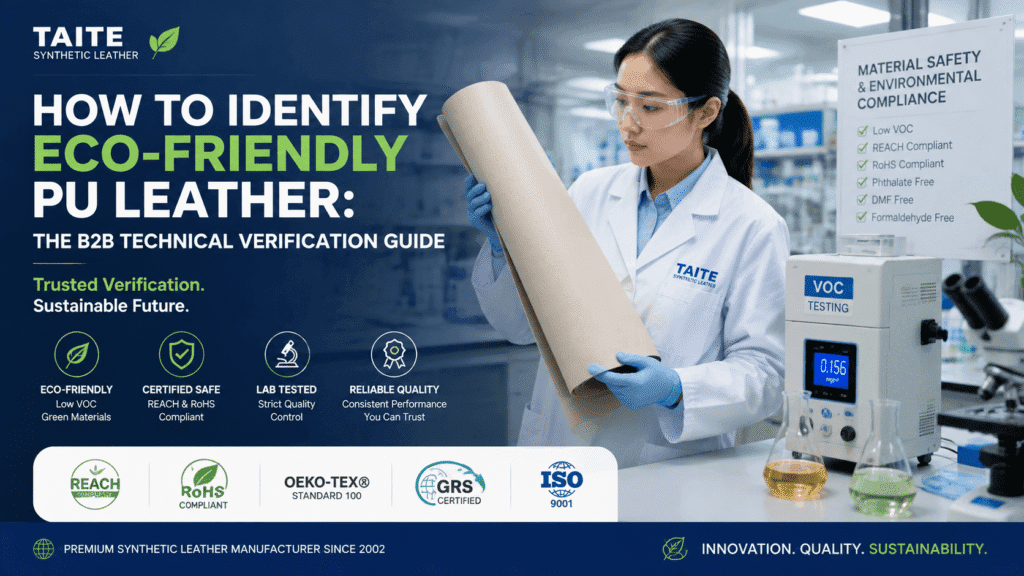
In today’s commercial upholstery, automotive, and high-end consumer goods markets, sustainability is no longer an optional marketing buzzword—it is a strict regulatory and procurement requirement. However, as demand for sustainable materials surges, so does the prevalence of “greenwashing.” Many suppliers label standard synthetic materials as “vegan” or “eco-friendly” simply because they do not contain animal hide, while completely ignoring toxic solvent emissions and non-recyclable chemical formulations during production.
For procurement managers, material engineers, and quality assurance directors, relying on vague supplier promises is a massive risk. True eco friendly PU leather must be verified through rigorous chemical testing, standardized environmental certifications, and transparent supply chain metrics.
In this technical guide, we will break down the molecular differences between traditional and sustainable polyurethanes, outline the 5 scientific benchmarks used to identify authentic eco friendly PU leather, and provide a quantitative inspection framework for your next B2B material sourcing cycle.
What Makes Polyurethane Synthetic Leather “Eco-Friendly”?
To understand eco-friendly synthetic leather, one must look at the traditional manufacturing process. Standard PU leather production historically relies on organic solvents—most notably Dimethylformamide (DMF / DMFa)—to dissolve polyurethane resins before coating them onto a fabric substrate. During curing and drying, DMF releases high levels of Volatile Organic Compounds (VOCs), poses severe health risks to factory workers, and leaves toxic chemical residues in the finished material.
Genuine eco friendly PU leather re-engineers this chemical process from the ground up to eliminate environmental toxicity and minimize carbon footprint.
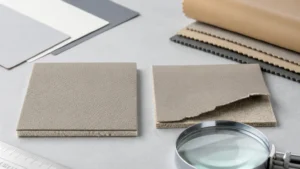
| Evolution of Eco-Friendly PU Leather Technology | ||
|---|---|---|
| 1. Traditional PU | 2. Water-Based PU (WBPU) | 3. Solvent-Free PU (Taite) |
|
|
|
The Three Main Categories of Sustainable PU:
- Water-Based PU Leather (WBPU): Uses water instead of organic solvents as the dispersing medium for polyurethane resin, resulting in zero DMF discharge during manufacturing.
- Solvent-Free PU Leather: Manufactured using a 100% solid-content liquid resin system that reacts and cures thermally without adding any liquid solvents. It represents the pinnacle of zero-VOC synthetic leather technology.
- Bio-Based PU Leather: Replaces a portion of petroleum-derived polyols with plant-based alternatives (such as castor oil, corn starch, or industrial agricultural waste), reducing fossil fuel dependence and overall life-cycle carbon emissions.
5 Technical Standards to Verify Eco-Friendly PU Leather
When auditing a factory or evaluating material swatches, implement these 5 laboratory and regulatory benchmarks to verify genuine eco-performance:
1. Gas Chromatography-Mass Spectrometry (GC-MS) for Zero DMF
The single most definitive test for eco friendly PU leather is verifying the absence of Dimethylformamide (DMFa).
- Testing Method: Laboratory GC-MS extraction testing (under EN 17131 or ISO 16189 standards).
- Verification Benchmark: Standard PU can contain up to 500–1000 ppm (parts per million) of residual DMF. Certified eco friendly PU leather must test below 10 ppm (often registering as “Not Detected” / ND), complying with strict European REACH Annex XVII regulations.
2. Volatile Organic Compound (VOC) & Odor Testing (VDA 270)
High VOC emissions cause the pungent “chemical smell” associated with cheap plastic materials and degrade indoor air quality in automotive cabins and office furniture.
- Testing Method: Thermal desorption analysis (ISO 16000-6) or the German Automotive Industry Standard VDA 270 (Olfactory Test).
- Verification Benchmark: Samples are sealed in a glass chamber heated to 80°C. Premium solvent-free PU leather achieves a VDA 270 odor rating of 1.5 to 2.0 (Virtually odorless), ensuring low total organic carbon (TOC) outgassing.
3. Bio-Based Carbon Content Certification (ASTM D6866)
If a supplier claims their material is “bio-based,” request an official ASTM D6866 laboratory report.
- Testing Method: Radiocarbon dating techniques measure the ratio of fossil carbon ($C_{14}$ depleted) to renewable bio-based carbon.
- Verification Benchmark: High-grade bio-based eco friendly PU leather should contain 20% to 50%+ bio-based carbon content in its polyurethane matrix, explicitly verified by USDA BioPreferred or DIN CERTCO certificates.
4. Regulatory Chemical Certifications (REACH, RoHS, OEKO-TEX)
Material safety must be backed by third-party testing bodies (such as SGS, TÜV, or Intertek).
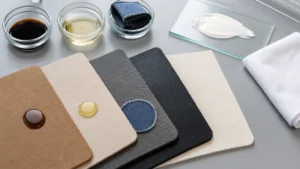
- REACH (EC 1907/2006): Ensures the material is free from Substances of Very High Concern (SVHCs), including phthalate plasticizers, heavy metals, and short-chain chlorinated paraffins (SCCPs).
- OEKO-TEX Standard 100 (Class I/II): Guarantees the material is dermatologically safe for prolonged human skin contact and free from harmful aromatic amines.
5. Hydrolysis & Physical Durability Balance
A material cannot be truly sustainable if it breaks down after two years and ends up in a landfill. True eco-efficiency requires long-term physical durability.
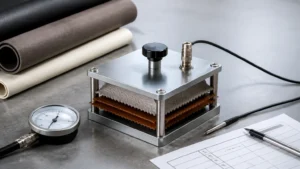
- Testing Method: Tropical Climate Testing / Jungle Test (ISO 1419 at 70°C and 95% Relative Humidity).
- Verification Benchmark: Premium solvent-free eco friendly PU leather should achieve 7 to 10+ weeks in the Jungle Test (equivalent to 7–10 years of real-world use) without coating delamination or cracking.
Technical Comparison: Traditional vs. Water-Based vs. Solvent-Free PU
Use this technical matrix to evaluate material parameters during your procurement planning:
| Technical Parameter | Traditional PU | Water-Based PU (WBPU) | Solvent-Free PU (Taite) |
|---|---|---|---|
| Solvent Carrier | DMF / Toluene / MEK | Water ($H_2O$) | None (100% Solid Reactants) |
| DMF Residual Level | 500 – 1000 ppm | < 10 ppm (REACH Compliant) | 0 ppm (Absolute Zero) |
| Выбросы летучих органических соединений | High Outgassing | Ultra-Low | Near Zero (VDA 270 Passed) |
| Tensile & Peel Strength | Standard | Moderate to High | Exceptional (High Density) |
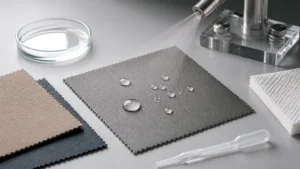
| Jungle Test Hydrolysis | 1 – 3 Weeks | 3 – 5 Weeks | 7 – 10+ Weeks |
Common Greenwashing Pitfalls in Synthetic Leather Procurement
When sourcing materials for global distribution, beware of these three common industry traps:
- “Vegan” Does Not Equal Eco-Friendly: PVC (Polyvinyl Chloride) is technically “vegan,” but it contains phthalate plasticizers and toxic chlorine compounds. Always specify non-PVC, solvent-free eco friendly PU leather.
- Eco-Friendly Topcoat with Toxic Adhesive: Some manufacturers apply a thin water-based topcoat over a standard solvent-based adhesive layer. Ensure that both the surface skin and the bonding resins are 100% solvent-free.
- Missing ISO 14001 Accreditation: A sustainable material must come from a sustainable factory. Verify that your manufacturing partner holds ISO 14001 (Environmental Management System) and operates closed-loop water treatment facilities.
Taite’s Technical Commitment to Sustainable Synthetic Leather
At Taite, engineering high-performance materials goes hand in hand with environmental responsibility. As a specialized manufacturer of mid-to-high-end synthetic leather, we have eliminated harmful solvents from our core product lines through advanced production chemistry.
Why global procurement engineers rely on Taite for sustainable materials:
- Certified Solvent-Free Formulations: Our flagship eco-friendly series utilizes 100% solid-state polyurethane resins, delivering zero DMF, zero VOCs, and complete compliance with EU REACH and California Proposition 65 standards.
- Uncompromised Durability: Unlike fragile eco-alternatives, Taite’s solvent-free PU leather delivers 100,000+ Martindale abrasion rubs and up to 10-year hydrolysis resistance, making it ideal for heavy-duty commercial upholstery and automotive seating.
- Full Chemical Transparency: Every production batch undergoes strict internal GC-MS screening, and we provide comprehensive SGS/Intertek test certificates with every Technical Data Sheet (TDS).
Conclusion: Verify Before You Procure
Transitioning to eco friendly PU leather is essential for meeting modern consumer expectations and global regulatory compliance. By auditing material specifications through GC-MS DMF testing, VOC emissions standards, and certified bio-based metrics, your engineering team can confidently select materials that protect both the environment and your brand reputation.
Are you looking to upgrade your product line with lab-certified, high-durability sustainable synthetic leather?