

Synthetic leather thickness is one of the most requested specifications in B2B sourcing — and one of the most misunderstood. Buyers often assume thicker material is automatically better, but the right thickness depends entirely on the application. This guide explains what synthetic leather thickness actually means, how it is measured, how it affects performance, and how to choose the correct thickness for your product.
What Is Synthetic Leather Thickness?
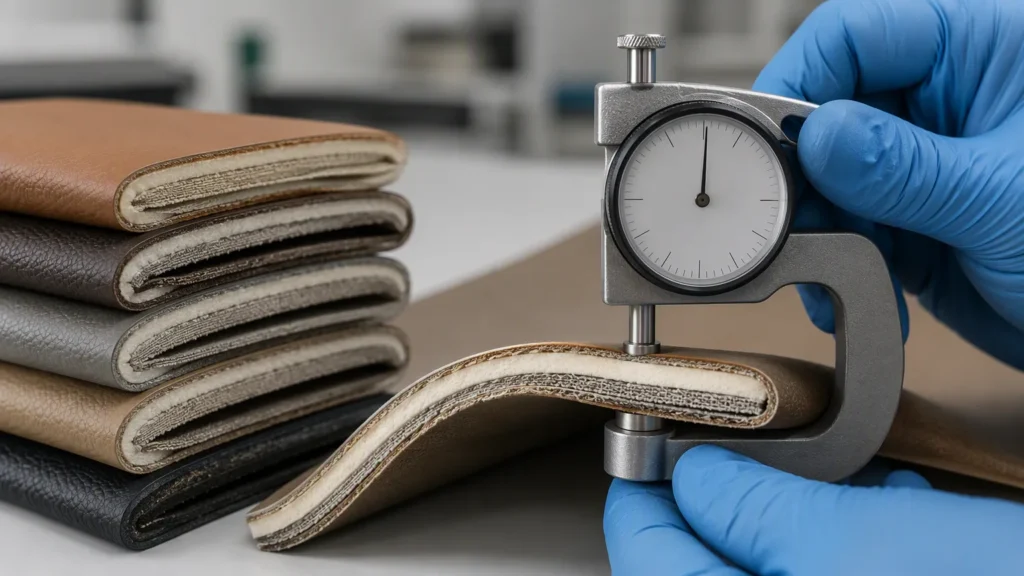
Synthetic leather thickness refers to the total measured depth of the material, from the top surface to the back of the base fabric. Unlike a single homogeneous sheet, synthetic leather is a layered structure, and each layer contributes to the total thickness:
- Surface coating: the top PU or PVC layer that provides texture, color, and abrasion resistance.
- Foam or skin layer: the middle layer that gives the material its hand feel, softness, and cushioning.
- Base fabric (backing): the woven or knitted textile that provides tensile strength and dimensional stability.
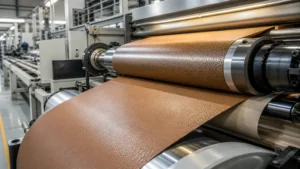
Because of this construction, two materials with the same total thickness can perform very differently depending on how that thickness is distributed between layers. This is why thickness must always be read alongside the overall build of the material, which is determined during the synthetic leather manufacturing process.
How Synthetic Leather Thickness Is Measured
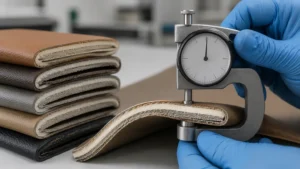
Thickness is expressed in millimeters (mm) and measured with a calibrated thickness gauge. For a reliable reading, the process follows a few technical rules:
- Constant pressure: the gauge applies a fixed, standardized pressure so that soft foam layers are not over-compressed, which would understate the true thickness.
- Multiple points: readings are taken at several locations across the sample and averaged, since coating and foam are never perfectly uniform.
- Flat, tension-free sample: the material is laid flat without stretching, as tension distorts the reading.
This is why a supplier’s measured thickness is more reliable than a “feels thick” impression — hand feel is influenced by foam softness, not just true depth.
Thickness vs Weight (mm vs gsm)
Thickness (mm) and weight (gsm — grams per square meter) are related but not interchangeable. Thickness measures depth; gsm measures mass per unit area. A dense, compact material can be thin but heavy, while a highly foamed material can be thick but light. Professional specifications often list both, because together they describe the material far more accurately than either alone.
Why Thickness Readings Can Vary
Even for the same material, thickness readings can differ between suppliers if the measurement conditions are not standardized. The main variables are the pressure applied by the gauge, the number and location of measurement points, and whether the sample is under tension. Foam-heavy constructions are especially sensitive, because too much gauge pressure compresses the foam and reports a lower value than the material’s true relaxed thickness. When comparing quotes from multiple suppliers, always confirm that everyone is measuring to the same standard — otherwise you may be comparing numbers that were never taken the same way.
How Thickness Affects Performance
Synthetic leather thickness directly influences durability, feel, and cost. Understanding these trade-offs helps you avoid over-specifying or under-specifying your material:
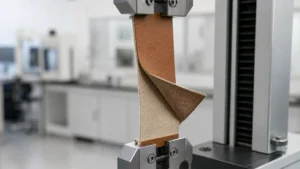
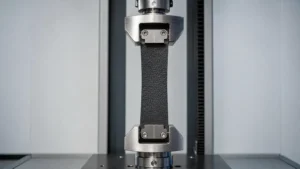
- Durabilidade: a thicker coating and stronger backing generally improve abrasion and tear resistance — but only if the layers are well engineered. You can confirm this with a tensile and tear strength test and a Martindale abrasion test.
- Hand feel and rigidity: thinner material is softer and more flexible, which suits garments and linings; thicker material is firmer and more structured, which suits upholstery and cases.
- Weight and cost: more material means higher raw-material cost and added weight, which matters for shipping and for wearable products.
The goal is not maximum thickness — it is the right thickness for the stress the product will actually face.
It also helps to think about thickness across the product’s whole life cycle. A material that feels adequately firm on day one can still fail early if the coating is too thin to resist repeated abrasion, or if the backing is too light to hold stitching under load. This is why experienced buyers pair a synthetic leather thickness target with performance testing rather than relying on the number in isolation — the thickness sets the baseline, and the test data confirms the material will hold up in real use.
Choosing the Right Thickness by Application
Different products demand different thickness ranges. The table below summarizes common application categories and the key consideration for each.
| Aplicação | Typical thickness tendency | Key consideration |
|---|---|---|
| Garments & linings | Thin | Softness and drape |
| Handbags & small goods | Medium | Balance of feel and structure |
| Furniture upholstery | Medium to thick | Durability and firmness |
| Automotive seating | Medium to thick | Abrasion and compliance |
| Footwear | Varies by part | Flex vs support per component |
For upholstery specifically, thickness works together with abrasion and flex performance — see our guide on how to choose PU leather for furniture for a full breakdown of the relevant specifications.
Thickness vs Quality: A Common Misconception
The most persistent myth in sourcing is that thicker synthetic leather is always higher quality. In reality, quality is determined by the engineering of each layer — the coating formulation, the foam density, and the strength of the backing — not by total depth alone. A well-built medium-thickness material with a strong backing will outperform a thick but poorly bonded one. Thickness is a specification to match to your application, not a quality score. To understand the fundamentals behind these layers, review what synthetic leather is and how its construction works.
Specifying Thickness With Your Supplier
To avoid costly mismatches, define your thickness requirement early and in measurable terms. State the target thickness in mm, the acceptable tolerance, and the intended application so the supplier can recommend the right build. A reliable manufacturer will confirm thickness with gauge measurements and provide test data on durability. For material standards and terminology, industry references such as the ISO standards catalogue are a useful starting point. When you are ready to specify material, our team can help match thickness, weight, and performance to your product requirements.
Perguntas mais frequentes
How is synthetic leather thickness measured?
Synthetic leather thickness is measured in millimeters using a calibrated thickness gauge that applies constant pressure. Readings are taken at multiple points and averaged, with the sample laid flat and free of tension for accuracy.
What is the difference between thickness (mm) and weight (gsm)?
Thickness measures the material’s depth in millimeters, while gsm measures mass per square meter. A material can be thin but dense and heavy, or thick but light and foamed, so specifications often list both.
Does thicker synthetic leather mean better quality?
No. Quality depends on the engineering of the coating, foam, and backing layers, not on total thickness. A well-built medium-thickness material can outperform a thick but poorly constructed one.
What thickness of synthetic leather do I need for upholstery?
Upholstery generally uses medium-to-thick material for durability and firmness, but the exact thickness depends on the specific use and abrasion demands. Share your application with your supplier so they can recommend the right build and confirm it with test data.